










Breaking News
 Walter Block Ejected From Mises Institute Over Defense Of Israel After October 7th
 The Permission Grid: A Blueprint for a Permanent Slave Class
 Banning The Export of Diesel Will Only Make A Bad Situation Worse
 SCARY, DARK, DIRECT, But Is It TRUE? You Decide
Top Tech News
 Tesla Model 3 killer charges from 10 to 97% in just 9 minutes
 World-first unpowered DNA computer sets speed record
 I Power 5 Buildings Off-Grid. Here's How
 The US government is pushing hard to get a working nuclear fission reactor into space by late 2028
 SpaceX Starmind AI in Space Radiator
 China Will Dominate Global Nuclear Energy Through 2035, Analyst Says
 These Absolutely Wild-Looking EVs Are Saudi Arabia's First Homegrown Cars
 BEYOND THE MOON: NASA plans a nuclear-powered fleet to push DEEPER into space
 Big Oil Backs Mazama's $135 Million Bet On Superhot Geothermal
 Quantum compass takes flight on Northrop's Lumberjack drone


Blood plasma infusions from young donors improves functional ability for Alzheimers
There were also some signs suggesting improvements in participants' conditions.
Above – Sharon Sha presented findings Nov. 4 from a small clinical trial that found administering blood plasma from young donors to people with mild to moderate Alzheimer's disease was safe. Paul Sakuma
Finding of safety wasn't surprising, given that blood-plasma infusions have long been in widespread use for other indications and are considered extremely safe. More surprising, she said, were hints of recipients' improvement on tests of functional ability: the capacity to perform basic tasks essential to independent daily life, such as remembering to take medications and being able to pay bills and prepare one's own meals.
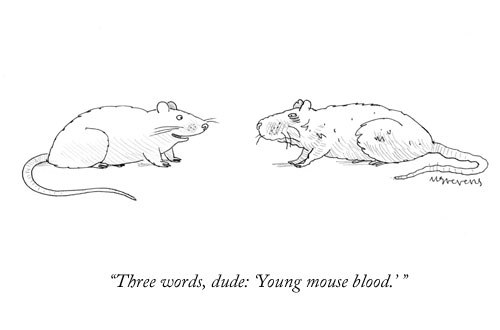
The PLASMA trial was designed to test a hypothesis advanced by Tony Wyss-Coray, PhD, Stanford professor of neurology and neurological sciences and a senior research career scientist at the Veterans Affairs Palo Alto Health Care System, whose research has shown that factors in the blood of young mice can rejuvenate the brain tissue and improve cognitive performance in old mice.