










Breaking News
 This is the future we shall bring into being
 Elon Musk's Vision For The Future Looks Like A Movie
 Phosphorus Munitions Fired by Israel Burn Groves, Orchards in Southern Lebanon
 Iran's IRGC Warns It Will Expand 'Geography of the War' If the US Attacks Again
Top Tech News
 BEYOND THE MOON: NASA plans a nuclear-powered fleet to push DEEPER into space
 Big Oil Backs Mazama's $135 Million Bet On Superhot Geothermal
 Quantum compass takes flight on Northrop's Lumberjack drone
 Terrifying AI Behavior Even Its Creators Couldn't Explain
 WW3 Near-Miss? AI Hallucinated Nuclear Weapons Components Aboard Chinese Vessel Bound For Iran
 Stripe Is Building the Toll Road for the Machine Economy
 Toyota Dakar hopeful swaps twin-turbo V6 for hydrogen fuel cells
 4-min turbo-inflatable cubic camp castle is now available in the USA
 Researchers Used Claude To Hack OpenAI Employee Accounts
 Chinese Scientists Develop New Oil Refining Method That Cuts Energy Use by 90%



Ultra-thin, curvy concrete roof is a monument to digital design
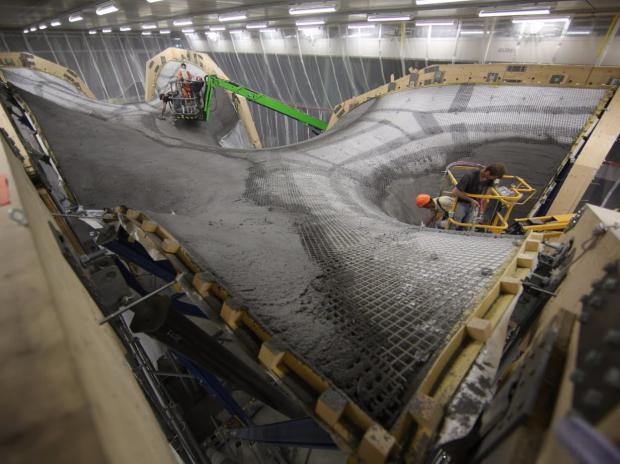
Now, engineers at ETH Zurich have developed a more efficient method for building with the material, erecting an ultra-thin, curved prototype roof that's 5 cm (2 in) thick on average, and designed to support energy-saving systems in the building.
Although it's since been dismantled to make way for other test structures, the prototype stood 7.5 m (24.6 ft) tall and was ultra-thin, measuring 12 cm (4.7 in) at its thickest and just 3 cm (1.2 in) at the edges. It had a surface area of 160 m2 (1,722 sq ft) and covered an area of 120 m2 (1,292 sq ft), and that discrepancy was down to the fact that the roof arched over, forming shapes that concrete normally wouldn't be capable of without complex support structures.
Instead of using custom-built, single-use wooden or foam scaffolding, the engineers tested a new technique of their own design. A net of steel cables was stretched into the desired shape, and a polymer textile was laid over the top to create a flexible formwork. The shape was controlled by algorithms that distribute the force evenly between the cables and determined just how much concrete needed to be applied to each section. Afterwards, the cable net can be dismantled, reused and reshaped as needed.