










Breaking News
 This Audi EV Set A Guinness World Record By Driving 831 Miles Without Recharging
 How US and China can nimbly escape the Thucydides Trap
 Taiwan's 'silicon shield' is in a race against time
 Bond vigilantes on a savage hunt as global yields run wild
Top Tech News
 Tesla Model 3 killer charges from 10 to 97% in just 9 minutes
 World-first unpowered DNA computer sets speed record
 I Power 5 Buildings Off-Grid. Here's How
 The US government is pushing hard to get a working nuclear fission reactor into space by late 2028
 SpaceX Starmind AI in Space Radiator
 China Will Dominate Global Nuclear Energy Through 2035, Analyst Says
 These Absolutely Wild-Looking EVs Are Saudi Arabia's First Homegrown Cars
 BEYOND THE MOON: NASA plans a nuclear-powered fleet to push DEEPER into space
 Big Oil Backs Mazama's $135 Million Bet On Superhot Geothermal
 Quantum compass takes flight on Northrop's Lumberjack drone


Shanghai to San Francisco in 100 minutes...
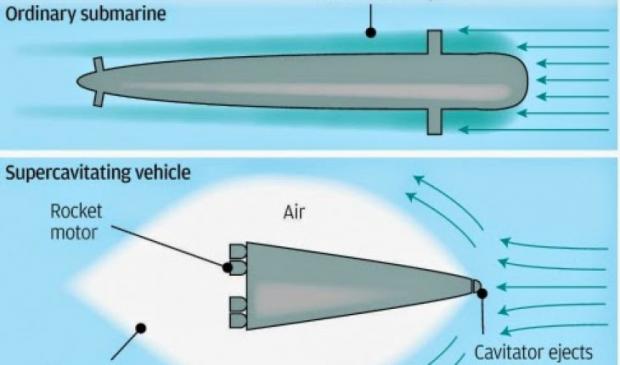
Since drag is proportional to the density of the surrounding fluid, the drag on a super-cavitating projectile is dramatically reduced, allowing supercavitating projectiles to attain higher speeds than conventional projectiles. In water , a rough approximation predicts that a supercavitating projectile has 200,000 times less skin friction than a normal projectile. The potential applications are impressive.
Here we will describe the advances that the chinese researchers have made towards practical supercavitating submarines and the need for molten salt nuclear reactors to power them. Molten salt nuclear reactors are under commercial development in Canada, China and other countries. Molten salt reactors could achieve 50 times the power density of current nuclear reactors used in nuclear submarines.
A 650 MW thermal integrated molten salt reactor with a supercritical CO2 turbine would have about 400 MWe of power with about 200 tons of weight. This would be about 2 kW per kg.