










Breaking News
 This Audi EV Set A Guinness World Record By Driving 831 Miles Without Recharging
 How US and China can nimbly escape the Thucydides Trap
 Taiwan's 'silicon shield' is in a race against time
 Bond vigilantes on a savage hunt as global yields run wild
Top Tech News
 Tesla Model 3 killer charges from 10 to 97% in just 9 minutes
 World-first unpowered DNA computer sets speed record
 I Power 5 Buildings Off-Grid. Here's How
 The US government is pushing hard to get a working nuclear fission reactor into space by late 2028
 SpaceX Starmind AI in Space Radiator
 China Will Dominate Global Nuclear Energy Through 2035, Analyst Says
 These Absolutely Wild-Looking EVs Are Saudi Arabia's First Homegrown Cars
 BEYOND THE MOON: NASA plans a nuclear-powered fleet to push DEEPER into space
 Big Oil Backs Mazama's $135 Million Bet On Superhot Geothermal
 Quantum compass takes flight on Northrop's Lumberjack drone


New type of supercomputer could be based on 'magic dust' combination of light and matter
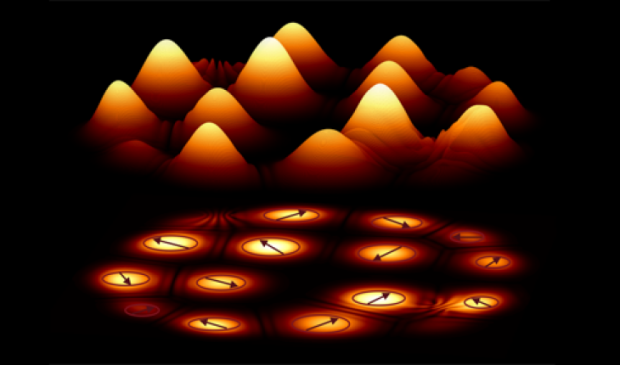
The researchers, from Cambridge, Southampton and Cardiff Universities in the UK and the Skolkovo Institute of Science and Technology in Russia, have used quantum particles known as polaritons – which are half light and half matter – to act as a type of 'beacon' showing the way to the simplest solution to complex problems. This entirely new design could form the basis of a new type of computer that can solve problems that are currently unsolvable, in diverse fields such as biology, finance or space travel. The results are reported in the journal Nature Materials.
Our technological progress — from modelling protein folding and behaviour of financial markets to devising new materials and sending fully automated missions into deep space — depends on our ability to find the optimal solution of a mathematical formulation of a problem: the absolute minimum number of steps that it takes to solve that problem.
The search for an optimal solution is analogous to looking for the lowest point in a mountainous terrain with many valleys, trenches, and drops. A hiker may go downhill and think that they have reached the lowest point of the entire landscape, but there may be a deeper drop just behind the next mountain. Such a search may seem daunting in natural terrain, but imagine its complexity in high-dimensional space.