










Breaking News
 Democrats Celebrate El-Sayed Victory By Firing AK-47s Into The Air
 Who Decides What Makes A "Good" School?
 US DOJ relying on anonymous Israeli intel agent to convict US resident of Oct 7 participation
 Tensions Flicker into Flame, Lapping Across the Middle East
Top Tech News
 Voyager 1 approaches one light day from Earth
 Visual Implants
 Renewable Energy Breakthrough! World's Most Efficient Tesla Turbine System
 I Told You So
 Meet Sunbird, a nuclear fusion-powered space tug concept from Pulsar Fusion.
 China and Russia launch 29-nation AI alliance to rival western control of technology
 BREAKING: China has begun manufacturing domestically developed Immersion Deep...
 Idaho's High Desert Becomes Hot Spot For Nuclear Power Revolution
 The World's Largest Electric Aircraft Is About to Take Its First Flight
 Tesla Cybercabs and Superchargers Will Act as Mini Cell Towers for SpaceX Starlink



New ultrathin semiconductor materials exceed some of silicon's capabilities
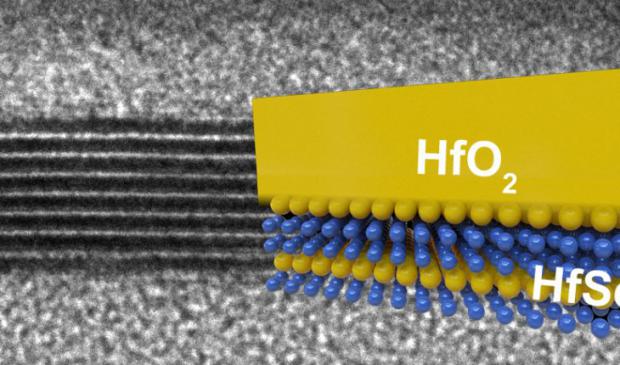
In this greatly enlarged cross-section of an experimental chip, the bands of black and white reveal alternating layers of hafnium diselenide – an ultrathin semiconductor material – and the hafnium dioxide insulator. The cross-section matches an overlaid color schematic on the right. (Image credit: Michal Mleczko)
The new materials can also be shrunk to functional circuits just three atoms thick and they require less energy than silicon circuits. Although still experimental, the researchers said the materials could be a step toward the kinds of thinner, more energy-efficient chips demanded by devices of the future.
Science Advances – HfSe2 and ZrSe2: Two-dimensional semiconductors with native high-κ oxides
Silicon's strengths
Silicon has several qualities that have led it to become the bedrock of electronics, Pop explained. One is that it is blessed with a very good "native" insulator, silicon dioxide or, in plain English, silicon rust. Exposing silicon to oxygen during manufacturing gives chip-makers an easy way to isolate their circuitry. Other semiconductors do not "rust" into good insulators when exposed to oxygen, so they must be layered with additional insulators, a step that introduces engineering challenges. Both of the diselenides the Stanford group tested formed this elusive, yet high-quality insulating rust layer when exposed to oxygen.