










Breaking News
 Evacuations begin as 'blockbuster' nor'easter barrels toward millions in 12 US states
 Trump's military prepares for Cuba as leaked Pentagon memo sends telling signal...
 Ford v. Hyundai: Henry Ford Must Be Turning In His Grave After New Report
 Switzerland Is Still The Most Expensive Place In The World To Eat Out
Top Tech News
 Tesla Model 3 killer charges from 10 to 97% in just 9 minutes
 World-first unpowered DNA computer sets speed record
 I Power 5 Buildings Off-Grid. Here's How
 The US government is pushing hard to get a working nuclear fission reactor into space by late 2028
 SpaceX Starmind AI in Space Radiator
 China Will Dominate Global Nuclear Energy Through 2035, Analyst Says
 These Absolutely Wild-Looking EVs Are Saudi Arabia's First Homegrown Cars
 BEYOND THE MOON: NASA plans a nuclear-powered fleet to push DEEPER into space
 Big Oil Backs Mazama's $135 Million Bet On Superhot Geothermal
 Quantum compass takes flight on Northrop's Lumberjack drone


Existing 51 qubit quantum simulator using rubidium atoms could scale to hundreds...
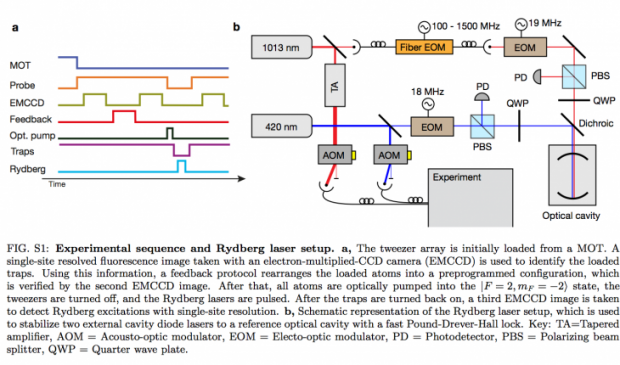
In Juy, Mikhail Lukin at Harvard University announced they had a 51 quantum bit simulator. Quantum simulators are used to model the minute behavior of molecules, and could help study how drugs act within the human body. They aren't full-blown quantum computers, though, says Simon Devitt at Macquarie University in Sydney.
Lukin and his team use of atom-by-atom assembly to deterministically prepare arrays of individually trapped
cold neutral 87Rb atoms in optical tweezers (lasers hold and manipulate the atoms). Controlled, coherent interactions between these atoms are introduced by coupling them to Rydberg states. Such interactions have already been used for realizing quantum gates, implementing strong photon-photon interactions and studying many-body physics.
The protocol that they implement is depicted.