










Breaking News
 The Property Rights Duality and the Defense of Freedom
 Japan Looks To Palantir For Battlefield AI
 Louisiana Has The Highest Car Ownership Burden In America
 Pharma Looks to Cash in on Psychedelics as Patients Seek Alternatives to Psychotropic Drugs...
Top Tech News
 Voyager 1 approaches one light day from Earth
 Visual Implants
 Renewable Energy Breakthrough! World's Most Efficient Tesla Turbine System
 I Told You So
 Meet Sunbird, a nuclear fusion-powered space tug concept from Pulsar Fusion.
 China and Russia launch 29-nation AI alliance to rival western control of technology
 BREAKING: China has begun manufacturing domestically developed Immersion Deep...
 Idaho's High Desert Becomes Hot Spot For Nuclear Power Revolution
 The World's Largest Electric Aircraft Is About to Take Its First Flight
 Tesla Cybercabs and Superchargers Will Act as Mini Cell Towers for SpaceX Starlink



Supertiny cameras could shrink from pill size to dust size
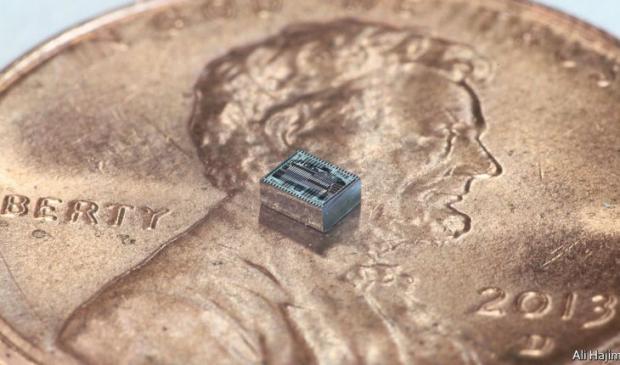
Ali Hajimiri of the California Institute of Technology will make far smaller cameras. His team plan to replace them with truly minuscule devices that spurn every aspect of current photographic technology. Not only do Dr Hajimiri's cameras have no moving parts, they also lack lenses and mirrors—in other words, they have no conventional optics. That does away with the focal depth required by today's cameras, enabling the new devices to be flat.
Caltech engineers developed the new camera design that replaces the lenses with an ultra-thin optical phased array (OPA). The OPA does computationally what lenses do using large pieces of glass: it manipulates incoming light to capture an image.
The new system can selectively look in a desired direction and at a very small part of the picture in front of you at any given time, by controlling the timing with femto-second—quadrillionth of a second—precision.