










Breaking News
 California Declares State Of Emergency Ahead Of Strong El Niño
 'Pausing' Intensifies: OpenAI Unleashes Latest Model Minutes After Dario Dumps Magnum Opus
 Trump Calls For Diesel Export Ban After 3-Hour 'Very Productive' Iran Talks
 Wendy's faces 300 closures across 15 states due to crippling beef prices
Top Tech News
 BEYOND THE MOON: NASA plans a nuclear-powered fleet to push DEEPER into space
 Big Oil Backs Mazama's $135 Million Bet On Superhot Geothermal
 Quantum compass takes flight on Northrop's Lumberjack drone
 Terrifying AI Behavior Even Its Creators Couldn't Explain
 WW3 Near-Miss? AI Hallucinated Nuclear Weapons Components Aboard Chinese Vessel Bound For Iran
 Stripe Is Building the Toll Road for the Machine Economy
 Toyota Dakar hopeful swaps twin-turbo V6 for hydrogen fuel cells
 4-min turbo-inflatable cubic camp castle is now available in the USA
 Researchers Used Claude To Hack OpenAI Employee Accounts
 Chinese Scientists Develop New Oil Refining Method That Cuts Energy Use by 90%



This Solar-Powered Device Sucks Drinking Water Out of Thin Air
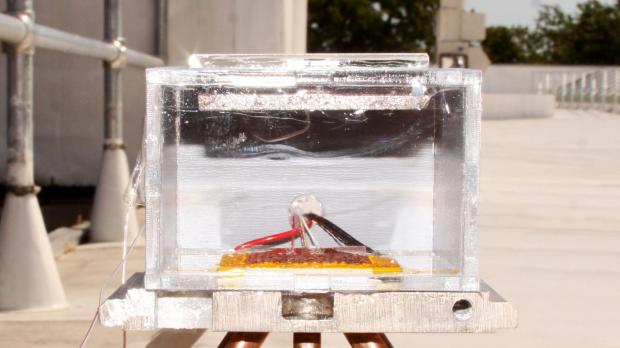
Scientists have created a solar-powered device that can get drinkable water from air in the desert. If future space travellers visit a dry desert planet and need to find a drink, it's possible they could one day use a similar device there, too, but in the meantime, something like this could be a huge help to water-deprived people who live in arid climates.
The device, which looks a little like the EG-series power droid from Star Wars, uses a custom-built metal-organic framework (MOF) to seek out water, even in dry climates with humidity as low as 20 per cent, and trap it in vapour form. It's reported in the journal Science.
MOFs are one, two, or three-dimensional chemical compounds. If chemistry were a toy chest, MOFs would be made using a box of Straws and Connectors. Their look depends on which metal ion or cluster of metal ions (connectors) are linked by whichever organic molecule (straws). MOFs are extremely versatile because their chemical characteristics can be modified according to different uses.