










Breaking News
 Is Big Pharma Selling Postpartum Depression to New Moms?
 Make Men Men Again: Low T Is Now a National Defense Problem
 Druski: They're Lying To You About Overnight Success!
 $6.27 Diesel Just Hit Harvest. The Grocery Aisle Hasn't Felt It Yet.
Top Tech News
 Tesla Model 3 killer charges from 10 to 97% in just 9 minutes
 World-first unpowered DNA computer sets speed record
 I Power 5 Buildings Off-Grid. Here's How
 The US government is pushing hard to get a working nuclear fission reactor into space by late 2028
 SpaceX Starmind AI in Space Radiator
 China Will Dominate Global Nuclear Energy Through 2035, Analyst Says
 These Absolutely Wild-Looking EVs Are Saudi Arabia's First Homegrown Cars
 BEYOND THE MOON: NASA plans a nuclear-powered fleet to push DEEPER into space
 Big Oil Backs Mazama's $135 Million Bet On Superhot Geothermal
 Quantum compass takes flight on Northrop's Lumberjack drone


Tiny fibers open new windows into the brain
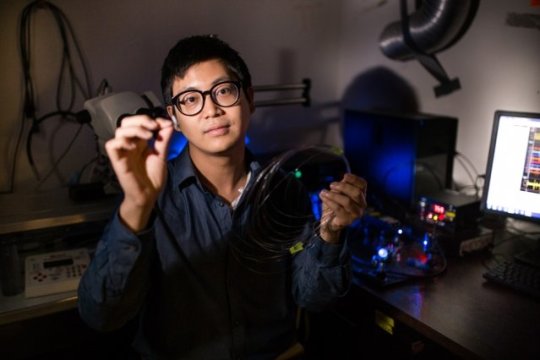
For the first time, a single multifunction flexible fiber no bigger than a human hair, has successfully delivered a combination of optical, electrical and chemical signals back and forth into the brain.
For the first time ever, a single flexible fiber no bigger than a human hair has successfully delivered a combination of optical, electrical, and chemical signals back and forth into the brain, putting into practice an idea first proposed two years ago. With some tweaking to further improve its biocompatibility, the new approach could provide a dramatically improved way to learn about the functions and interconnections of different brain regions.
The new fibers were developed through a collaboration among material scientists, chemists, biologists, and other specialists. The results are reported in the journal Nature Neuroscience, in a paper by Seongjun Park, an MIT graduate student; Polina Anikeeva, the Class of 1942 Career Development Professor in the Department of Materials Science and Engineering; Yoel Fink, a professor in the departments of Materials Science and Engineering, and Electrical Engineering and Computer Science; Gloria Choi, the Samuel A. Goldblith Career Development Professor in the Department of Brain and Cognitive Sciences, and 10 others at MIT and elsewhere.