










Breaking News
 Is Big Pharma Selling Postpartum Depression to New Moms?
 Make Men Men Again: Low T Is Now a National Defense Problem
 Druski: They're Lying To You About Overnight Success!
 $6.27 Diesel Just Hit Harvest. The Grocery Aisle Hasn't Felt It Yet.
Top Tech News
 Tesla Model 3 killer charges from 10 to 97% in just 9 minutes
 World-first unpowered DNA computer sets speed record
 I Power 5 Buildings Off-Grid. Here's How
 The US government is pushing hard to get a working nuclear fission reactor into space by late 2028
 SpaceX Starmind AI in Space Radiator
 China Will Dominate Global Nuclear Energy Through 2035, Analyst Says
 These Absolutely Wild-Looking EVs Are Saudi Arabia's First Homegrown Cars
 BEYOND THE MOON: NASA plans a nuclear-powered fleet to push DEEPER into space
 Big Oil Backs Mazama's $135 Million Bet On Superhot Geothermal
 Quantum compass takes flight on Northrop's Lumberjack drone


New Laser Based on Unusual Physics Phenomenon Could Improve Telecommunications, Computing and More
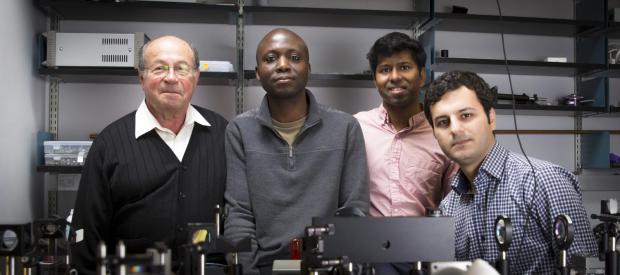
The technology could revolutionize the development of surface lasers, making them more compact and energy-efficient for communications and computing applications. The new BIC lasers could also be developed as high-power lasers for industrial and defense applications.
"Lasers are ubiquitous in the present day world, from simple everyday laser pointers to complex laser interferometers used to detect gravitational waves. Our current research will impact many areas of laser applications," said Ashok Kodigala, an electrical engineering Ph.D. student at UC San Diego and first author of the study.
"Because they are unconventional, BIC lasers offer unique and unprecedented properties that haven't yet been realized with existing laser technologies," said Boubacar Kanté, electrical engineering professor at the UC San Diego Jacobs School of Engineering who led the research.
BIC lasers can be readily tuned to emit beams of different wavelengths, a useful feature for medical lasers made to precisely target cancer cells without damaging normal tissue.