










Breaking News
 The Evil Within, Part 4: The Welfare State
 Watch Live: Jack Smith Testifies Before Senate Judiciary Committee
 This Invisible Thing Hitting Your Brain Every Day Could Be Why You Suffer From Brain Fog...
 Pete Hegseth unleashes on military high command with massive PURGE of generals amid Iran war
Top Tech News
 Tesla Model 3 killer charges from 10 to 97% in just 9 minutes
 World-first unpowered DNA computer sets speed record
 I Power 5 Buildings Off-Grid. Here's How
 The US government is pushing hard to get a working nuclear fission reactor into space by late 2028
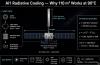 SpaceX Starmind AI in Space Radiator
 China Will Dominate Global Nuclear Energy Through 2035, Analyst Says
 These Absolutely Wild-Looking EVs Are Saudi Arabia's First Homegrown Cars
 BEYOND THE MOON: NASA plans a nuclear-powered fleet to push DEEPER into space
 Big Oil Backs Mazama's $135 Million Bet On Superhot Geothermal
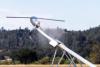 Quantum compass takes flight on Northrop's Lumberjack drone


Current Flywheels moving to Superconducting flywheels using carbon fiber...
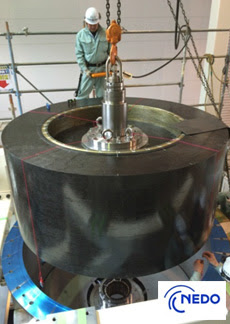
In 2015, Japan built the world's largest-class superconducting flywheel power storage system with a superconducting magnetic bearings. The completed system is the world's largest-class flywheel power storage system using a superconducting magnetic bearing. It has 300-kW output capability and 100-kWh storage capacity, and contains a CFRP (carbon-fiber-reinforced-plastic) flywheel. This flywheel is 2 meters in diameter and weighs 4 tons, and is rotated with a superconducting magnetic bearing at a maximum speed of 6,000 RPM. This is the world's first superconducting magnetic bearing which uses superconducting material both for its rotor and bearing, and is capable of supporting heavy weight, although it is a compact-sized system.
The flywheel is made by stacking nine layers of CFRP rotors with a 2-meter outer diameter, 1.4-meter inner diameter and 10-centimeter thickness. With this method, flywheels of different storage capacities can be made by changing the number of layers.
It had grid-connection tests with a megawatt-class solar power plant at Komekurayama in Yamanashi Prefecture.