










Breaking News
 California Declares State Of Emergency Ahead Of Strong El Niño
 'Pausing' Intensifies: OpenAI Unleashes Latest Model Minutes After Dario Dumps Magnum Opus
 Trump Calls For Diesel Export Ban After 3-Hour 'Very Productive' Iran Talks
 Wendy's faces 300 closures across 15 states due to crippling beef prices
Top Tech News
 BEYOND THE MOON: NASA plans a nuclear-powered fleet to push DEEPER into space
 Big Oil Backs Mazama's $135 Million Bet On Superhot Geothermal
 Quantum compass takes flight on Northrop's Lumberjack drone
 Terrifying AI Behavior Even Its Creators Couldn't Explain
 WW3 Near-Miss? AI Hallucinated Nuclear Weapons Components Aboard Chinese Vessel Bound For Iran
 Stripe Is Building the Toll Road for the Machine Economy
 Toyota Dakar hopeful swaps twin-turbo V6 for hydrogen fuel cells
 4-min turbo-inflatable cubic camp castle is now available in the USA
 Researchers Used Claude To Hack OpenAI Employee Accounts
 Chinese Scientists Develop New Oil Refining Method That Cuts Energy Use by 90%



The incredible thousand-year-old UNDERGROUND 18-storey city...
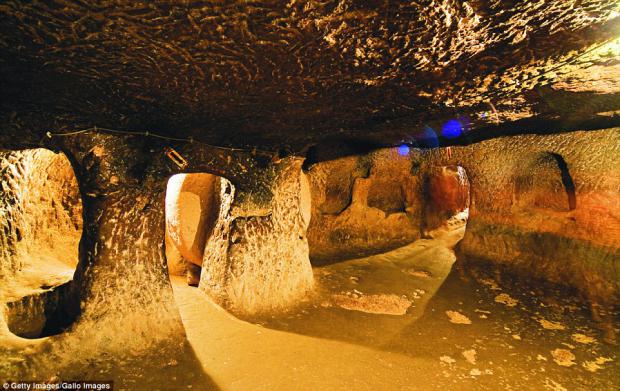
In 1963, a Turkish man in the region of Cappadocia was making improvements to his home when he made an incredible discovery.
After knocking down a wall in his basement, he stumbled upon a secret room, which led to an underground tunnel, which opened up into a completely hidden ancient city: Derinkuyu.
Photos of the preserved city reveal how 20,000 people - including livestock and entire food supplies - could have lived 18 storeys beneath the earth.
Thought to have been created during the Byzantine era in 780-1180AD, the network of kitchens, stables, churches, tombs, wells, communal rooms and schools was most likely used as a massive bunker to protect inhabitants from the Arab–Byzantine wars or natural disasters.
During this time, cave-like chapels and Greek inscriptions were added to the ancient city, and about 600 entrances allowed people to come and go.
Heavy stone doors could close Derinkuyu from the inside in order to fend off intruders, and each storey could be shut off individually.