










Breaking News
 India's Essar Group to invest $18 billion in US, build largest steel plant in American history
 US nuclear pact puts Saudi Arabia on path to the bomb
 "De-Globalization Endgame": Deutsche Bank Warns Historic Copper Squeeze Could Ignite 50% R
 Leaked Anthropic IPO Prospectus Shows $42BN Net Loss, $518BN In Unfunded Spending...
Top Tech News
 Tesla Model 3 killer charges from 10 to 97% in just 9 minutes
 World-first unpowered DNA computer sets speed record
 I Power 5 Buildings Off-Grid. Here's How
 The US government is pushing hard to get a working nuclear fission reactor into space by late 2028
 SpaceX Starmind AI in Space Radiator
 China Will Dominate Global Nuclear Energy Through 2035, Analyst Says
 These Absolutely Wild-Looking EVs Are Saudi Arabia's First Homegrown Cars
 BEYOND THE MOON: NASA plans a nuclear-powered fleet to push DEEPER into space
 Big Oil Backs Mazama's $135 Million Bet On Superhot Geothermal
 Quantum compass takes flight on Northrop's Lumberjack drone


In 2016 Supercomputers merged with AI and by 2018 there will AI machines with Exaflop power
The biggest developments in computing
* The Google Deep mind AI beat a worldclass champion Go player
* Current and future Supercomputers are mainly being built and targeted to advanced deep learning and artificial intelligence
* Deep learning is better than people at
* China made a supercomputer nearly three times faster than the previous fastest. The 93 petaflop Sunway TaihuLight
* The USA, Japan, Europe and China have funded projects to develop ExaFlop class supercomputers
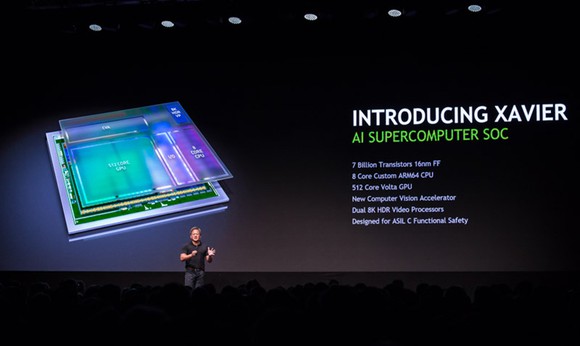
In 2016, Nvidia introduced Xavier, the most ambitious single-chip computer they have ever undertaken — the world's first AI supercomputer chip. Xavier is 7 billion transistors — more complex than the most advanced server-class CPU. Miraculously, Xavier has the equivalent horsepower of DRIVE PX 2 launched at CES earlier this year — 20 trillion operations per second of deep learning performance — at just 20 watts.