










Breaking News
 Those That Were Considered To Be "Dirt Poor" In 1987 Would Be Considered To Be Very Wealth
The Pedophile Protector-In-Chief Called Out On FOX News
 Josh Howerton - The War for Christianity | SRS #327
 Camp David Clash: Trump Hammered Hegseth For Misleading Him On Arms Supply, WaPo Reports
Top Tech News
 Voyager 1 approaches one light day from Earth
 Visual Implants
 Renewable Energy Breakthrough! World's Most Efficient Tesla Turbine System
 I Told You So
 Meet Sunbird, a nuclear fusion-powered space tug concept from Pulsar Fusion.
 China and Russia launch 29-nation AI alliance to rival western control of technology
 BREAKING: China has begun manufacturing domestically developed Immersion Deep...
 Idaho's High Desert Becomes Hot Spot For Nuclear Power Revolution
 The World's Largest Electric Aircraft Is About to Take Its First Flight
 Tesla Cybercabs and Superchargers Will Act as Mini Cell Towers for SpaceX Starlink



Race to Quantum Computing Supremacy should see definitive results in 2018
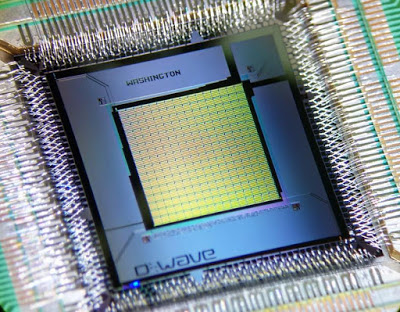
A critical question for the field of quantum computing in the near future is whether quantum devices without error correction can perform a well-defined computational task beyond the capabilities of state-of-the-art classical computers, achieving so-called quantum supremacy. We study the task of sampling from the output distributions of (pseudo-)random quantum circuits, a natural task for benchmarking quantum computers.
Crucially, sampling this distribution classically requires a direct numerical simulation of the circuit, with computational cost exponential in the number of qubits. This requirement is typical of chaotic systems. We extend previous results in computational complexity to argue more formally that this sampling task must take exponential time in a classical computer.
We study the convergence to the chaotic regime using extensive supercomputer simulations, modeling circuits with up to 42 qubits - the largest quantum circuits simulated to date for a computational task that approaches quantum supremacy. We argue that while chaotic states are extremely sensitive to errors, quantum supremacy can be achieved in the near-term with approximately fifty superconducting qubits.