










Breaking News
 'UNFAIR': Mamdani's city-run grocer plan SLAPPED with lawsuit
 Trump Says If Iran Had a Nuclear Weapon, He Would Have Politely Called the Supreme Leader...
 Tucker Carlson: We are on the brink of a world war that ends with the use of nuclear weapons
 Who is trying to destroy the United States and the world?
Top Tech News
 NASA Super Light Solar Sail Project Will Be 12-40 Times Lighter and Faster
 Space Telescope Interferometer to Image Exoplanet Continents
 Twenty-five years of "temporary": how 9/11 built a surveillance state Americans never vote
 I'll Never Buy Another WALMART Battery!
 Shoei GT-Air 3 Smart helmet drops with built-in AR for $1,500
 Freezable titanium plate keeps your cooler chilled way longer than ice packs
 Review: Affordable thermal device is made for discovering life outdoors
 AI Whistleblower Tells Tucker How AI Could Kill All Humans by 2040
 You Hate Flock? Well There's More...
 Will Spiking Diesel Prices Drive Autonomous Trucking?



Chocks away: Official debut for solar-powered space plane
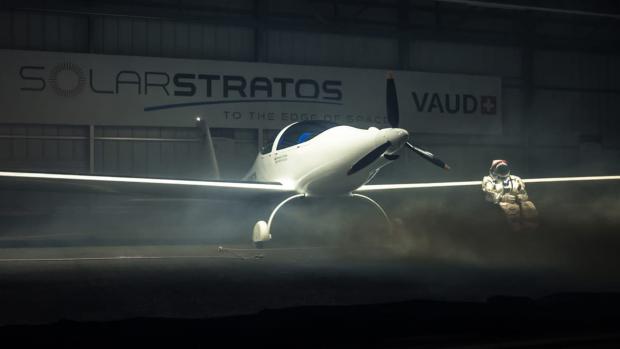
"Our goal is to demonstrate that current technology offers us the possibility to achieve above and beyond what fossil fuels offer," says project founder and pilot Raphaël Domjan in a press release. "Electric and solar vehicles are amongst the major challenges of the 21st century. Our aircraft can fly at an altitude of 25,000 m and this opens the door to the possibility of electric and solar commercial aviation, close to space."
The solar-electric plane is said to have an environmental footprint that is equivalent to that of an electric car and is aimed at offering an alternative to using large quantities of energy or helium as a means of reaching the stratosphere. It is 8.5-m (27.9-ft) long, has a wingspan of 24.8 m (81.4 ft) and weighs in at just 450 kg (992 lb).
The solar panel array charges a 20 kWh lithium-ion battery, which powers a 32-kW electric motor that in turn drives a 2.2-m (7.2-ft) propeller. SolarStratos says it is able to fly continuously for over 24 hours, which is more than enough to cover the expected two-and-a-half hours it will take to reach space, 15 minutes cruising at peak altitude and three hours to return to the Earth.