










Breaking News
 The Economist Who Predicted 2008 Explains China's Endgame
 Charlie Kirk SNAPS at Anti White Masked ANTIFA
 Episode 488: THE FAUCI FIRESTORM
 Discussion with Glen Diesen
Top Tech News
 Voyager 1 approaches one light day from Earth
 Visual Implants
 Renewable Energy Breakthrough! World's Most Efficient Tesla Turbine System
 I Told You So
 Meet Sunbird, a nuclear fusion-powered space tug concept from Pulsar Fusion.
 China and Russia launch 29-nation AI alliance to rival western control of technology
 BREAKING: China has begun manufacturing domestically developed Immersion Deep...
 Idaho's High Desert Becomes Hot Spot For Nuclear Power Revolution
 The World's Largest Electric Aircraft Is About to Take Its First Flight
 Tesla Cybercabs and Superchargers Will Act as Mini Cell Towers for SpaceX Starlink



Terahertz radiation could help us read closed books
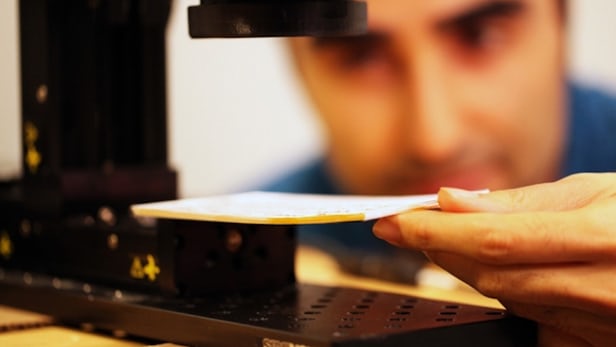
In their recent study, the team tested the system using a stack of papers with one letter printed on each and found that it could correctly identify those written on the top nine sheets.
The new system takes advantage of terahertz radiation – the band of electromagnetic radiation that lies between microwaves and infrared light on the electromagnetic spectrum. Although other wave types – such as X-rays – can also penetrate surfaces, the team chose to use terahertz radiation because it can differentiate between ink and blank paper in a way that X-rays cannot. This stems from the fact that different chemicals absorb different terahertz frequencies to varying degrees, giving each chemical – such as those used in ink and paper – a unique frequency signature.
MIT algorithms designed to capture images from each paper use this absorption difference to make the characters as clear as possible. Afterwards, algorithms developed by Georgia Tech were able to interpret the often-distorted images as letters.