










Breaking News
 The Economist Who Predicted 2008 Explains China's Endgame
 Charlie Kirk SNAPS at Anti White Masked ANTIFA
 Episode 488: THE FAUCI FIRESTORM
 Discussion with Glen Diesen
Top Tech News
 Voyager 1 approaches one light day from Earth
 Visual Implants
 Renewable Energy Breakthrough! World's Most Efficient Tesla Turbine System
 I Told You So
 Meet Sunbird, a nuclear fusion-powered space tug concept from Pulsar Fusion.
 China and Russia launch 29-nation AI alliance to rival western control of technology
 BREAKING: China has begun manufacturing domestically developed Immersion Deep...
 Idaho's High Desert Becomes Hot Spot For Nuclear Power Revolution
 The World's Largest Electric Aircraft Is About to Take Its First Flight
 Tesla Cybercabs and Superchargers Will Act as Mini Cell Towers for SpaceX Starlink



MIT and Microsoft Research made a 'smart' tattoo that remotely controls your phone
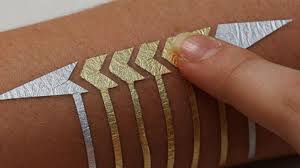
The technology, which is described on MIT's website and will be presented in full at a wearables symposium next month, is called DuoSkin. The researchers say you can design a circuit using any graphic software, stamp out the tattoo in gold leaf (which is conductive to electricity), and then apply other commodity materials and components that would make the tattoo interactive.
The paper presents three key use cases for the tattoo: you could use it to turn your skin into a trackpad, design it to change color based on temperature, or pull data from the tattoo. In one photo shared by MIT the tattoo even includes LED lights, creating a kind of glowing display on the skin.
This isn't the first time researchers have tried to turn our "dumb" epidermis into the equivalent of a touchscreen. Back in 2010 a Carnegie Mellon student, also in collaboration with Microsoft Research, came up with something called Skinput, which was designed to turn your wrist or the back of your hand into a "gestural finger input canvas."