










Breaking News
 No Benefits: Why Most Americans Hate The Idea Of AI Data Centers
 Are America's Youth Really Embracing Socialism?
 Are We About to See a Foreclosure WAVE Hit the US Housing Market?
 They Rolled Out the Relics - Then Cut the Working-Lands Money
Top Tech News
 World's smallest CT scanner fits in the palm of your hand
 The Tesla Roadster will blow people's minds
 Peter Thiel-Funded Company Anduril to Triple the Number of Autonomous Surveillance Towers...
 Quantum computing may soon become part of the microscope itself.
 Volkswagen Just Unveiled The Most Efficient EV Ever Tested
 NASA Super Light Solar Sail Project Will Be 12-40 Times Lighter and Faster
 Space Telescope Interferometer to Image Exoplanet Continents
 Twenty-five years of "temporary": how 9/11 built a surveillance state Americans never vote
 I'll Never Buy Another WALMART Battery!
 Shoei GT-Air 3 Smart helmet drops with built-in AR for $1,500



NASA blows up BEAM balloon room
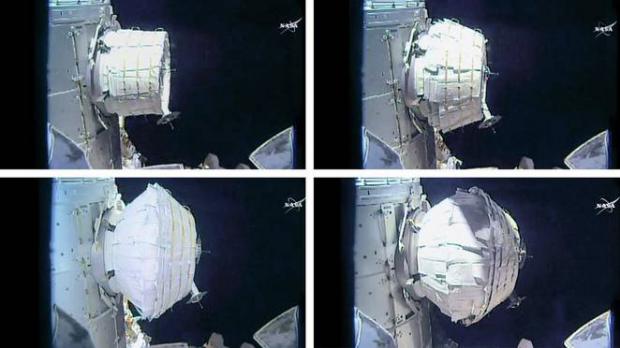
It takes up less room in the rocket, and weights a lot less. The internal air pressure gives it its shape; instead of fighting with air pressure, puts it to use. The skin is in tension, so it can have great strength to weight ratio. It's not just a thin layer, but thick enough to resist space debris and micrometeorites as well as the rest of the ISS; it is strong enough that it might make a neat yurt back on earth.
When they started inflating it on the first try, it didn't open properly; evidently the material was sticking together. According to Bigelow's press release:
The BEAM spacecraft has been in a packed state for a significantly longer time than expected. It has undergone a tremendous squeeze for over 15 months, which is 10 months longer than planned. Therefore, there is a potential for the behavior of the materials that make up the outside of the spacecraft to act differently than expected.