










Breaking News
 Is Big Pharma Selling Postpartum Depression to New Moms?
 Make Men Men Again: Low T Is Now a National Defense Problem
 Druski: They're Lying To You About Overnight Success!
 $6.27 Diesel Just Hit Harvest. The Grocery Aisle Hasn't Felt It Yet.
Top Tech News
 Tesla Model 3 killer charges from 10 to 97% in just 9 minutes
 World-first unpowered DNA computer sets speed record
 I Power 5 Buildings Off-Grid. Here's How
 The US government is pushing hard to get a working nuclear fission reactor into space by late 2028
 SpaceX Starmind AI in Space Radiator
 China Will Dominate Global Nuclear Energy Through 2035, Analyst Says
 These Absolutely Wild-Looking EVs Are Saudi Arabia's First Homegrown Cars
 BEYOND THE MOON: NASA plans a nuclear-powered fleet to push DEEPER into space
 Big Oil Backs Mazama's $135 Million Bet On Superhot Geothermal
 Quantum compass takes flight on Northrop's Lumberjack drone


SkyRunner MK 3.2 flying buggy launches in the sky and dirt
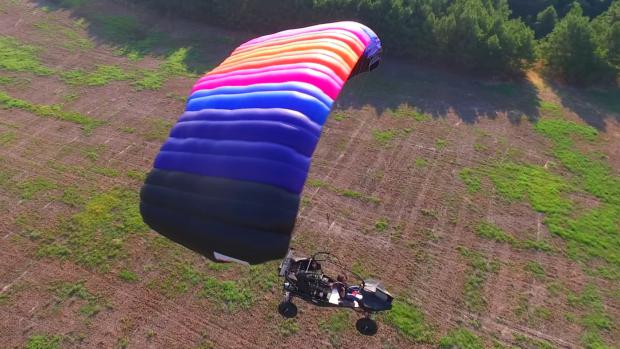
The SkyRunner can rip over the ground at speeds up to 70 mph (113 km/h), then shoot through the air at up to 52 mph (84 km/h) with a separate drive system. And now it can be yours ... for a price. We chatted with SkyRunner founder and CEO Stewart Hamel to learn more about the ins and outs of the newly redesigned air-ATV.
Hamel first became acquainted with British outfit Parajet Automotive while serving on the board of Oxford University's Saïd Business School. Through his investment company, he struck an agreement with Parajet to underwrite the design, testing, certification and production of a flying ATV to be named SkyRunner. From that agreement, the original SkyRunner made its soft debut in 2013, and reservations opened.
We haven't heard much about the SkyRunner since 2013, but that doesn't mean nothing's been happening. In fact, a whole lot has happened in those two and a half years. Parajet and SkyRunner have gone their separate ways, the former now advertising the SkyQuad, which appears to be closely related to the 2013 SkyRunner, if not the exact design. For its part, SkyRunner moved on from that design after an intensive research and development effort based entirely in the US. What's resulted is a completely new machine.