










Breaking News
 Is Big Pharma Selling Postpartum Depression to New Moms?
 Make Men Men Again: Low T Is Now a National Defense Problem
 Druski: They're Lying To You About Overnight Success!
 $6.27 Diesel Just Hit Harvest. The Grocery Aisle Hasn't Felt It Yet.
Top Tech News
 Tesla Model 3 killer charges from 10 to 97% in just 9 minutes
 World-first unpowered DNA computer sets speed record
 I Power 5 Buildings Off-Grid. Here's How
 The US government is pushing hard to get a working nuclear fission reactor into space by late 2028
 SpaceX Starmind AI in Space Radiator
 China Will Dominate Global Nuclear Energy Through 2035, Analyst Says
 These Absolutely Wild-Looking EVs Are Saudi Arabia's First Homegrown Cars
 BEYOND THE MOON: NASA plans a nuclear-powered fleet to push DEEPER into space
 Big Oil Backs Mazama's $135 Million Bet On Superhot Geothermal
 Quantum compass takes flight on Northrop's Lumberjack drone


Inexpensive 3D-printed lens gives terahertz imaging a boost
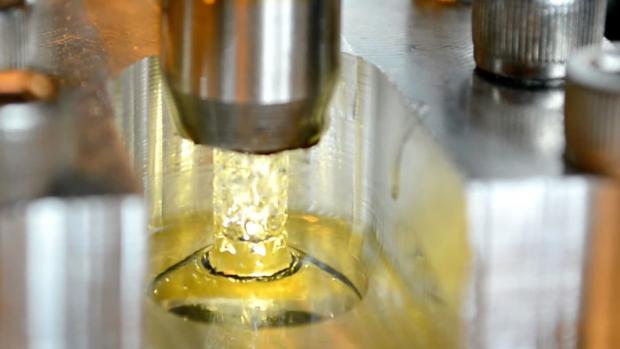
Now researchers have developed a way of manufacturing lenses operating at this frequency that are simple and inexpensive, but are claimed to produce near-flawless images which could vastly improve biomedical imaging as well as biological and explosive security scanning.
Terahertz frequencies are located between the microwave and infrared frequencies in the in the electromagnetic spectrum, at a wavelength range between 1 mm to 0.1 mm, and have some particularly remarkable properties. Many ordinary materials and living tissue, for example, are semi-transparent to this radiation and produce their own unique "fingerprints," that allows them to be individually identified as well as imaged and analyzed.
"Terahertz is somewhat of a gap between microwaves and infrared," says Northwestern University's Associate Professor of Mechanical Engineering, Cheng Sun. "People are trying to fill in this gap because this spectrum carries a lot of information."