










Breaking News
 India's Essar Group to invest $18 billion in US, build largest steel plant in American history
 US nuclear pact puts Saudi Arabia on path to the bomb
 "De-Globalization Endgame": Deutsche Bank Warns Historic Copper Squeeze Could Ignite 50% R
 Leaked Anthropic IPO Prospectus Shows $42BN Net Loss, $518BN In Unfunded Spending...
Top Tech News
 Tesla Model 3 killer charges from 10 to 97% in just 9 minutes
 World-first unpowered DNA computer sets speed record
 I Power 5 Buildings Off-Grid. Here's How
 The US government is pushing hard to get a working nuclear fission reactor into space by late 2028
 SpaceX Starmind AI in Space Radiator
 China Will Dominate Global Nuclear Energy Through 2035, Analyst Says
 These Absolutely Wild-Looking EVs Are Saudi Arabia's First Homegrown Cars
 BEYOND THE MOON: NASA plans a nuclear-powered fleet to push DEEPER into space
 Big Oil Backs Mazama's $135 Million Bet On Superhot Geothermal
 Quantum compass takes flight on Northrop's Lumberjack drone


Roborace previews its autonomous, driverless race car
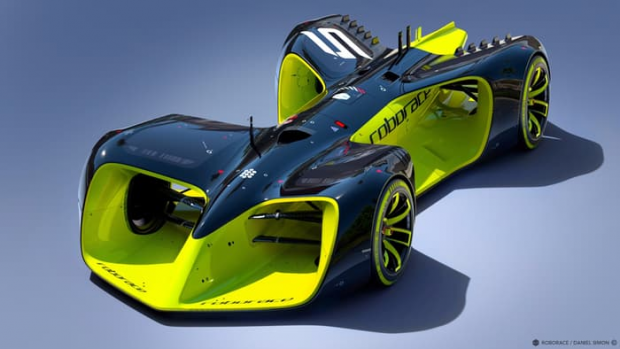
As we reported last year, plans are for the Roborace autonomous racing series to run in conjunction with Formula E, starting in the 2016-17 season. Last week, newly-appointed design chief Daniel Simon, who has a diverse background designing concept cars for both global automakers and Hollywood, released the first look at the driverless Roborace car.
The lack of a need for a driver's cockpit has dropped barriers and opened up design freedom, allowing Simon and his team to follow aerodynamics even more closely than on the typical race car. The result, dubbed the Robocar, looks like a streamliner-style fuselage with four massive nostril-fenders optimizing downforce. Those large intakes allow air to flow straight through the body work over top the open floor.
"It was important to us that we generate substantial downforce without unnecessary parts cluttering the car to maintain a clean and iconic look," Simon explains. "This is largely made possible by using the floor as the main aerodynamic device and we are currently developing active body parts that are more organic and seamless than solutions today."