









Breaking News
 Always Thirsty, Dizzy & Tired? It's Not More Water You Need
 What Makes The Best Jerky? The Bearded Butchers Compare!
 Iran War: Trump Sowed The Wind, And Is Reaping The Whirlwind
 "It's Coming And It's Serious..." - Martin Armstrong
Top Tech News
 I Built a Website to Expose Solar and Battery Scams
 Whistleblower Issues Dire Warning: Rogue AI, Hacking Nuclear Programs...
 Multi-material insulation delivers up to 10,000 x the stiffness
 Anduril's plan to save US sub edge from China's undersea surge
 Researchers Develop AI 'Mind-Reading' Tool That Reconstructs What Your Eyes See
 Video: Dexterous robot hand learns the delicate art of silk embroidery
 The computer that can read your mind:
 Seven apps. One craft
 SHOCK CASE REPORT: Advanced Alzheimer's Patient Regains Speech, Memory, Mobility...
 Most artificial limbs rely on silicone or plastic to mimic human hands.



Teen's Disaster Messaging App Can 'Hop' Across Bluetooth When Cellular Networks Collapse
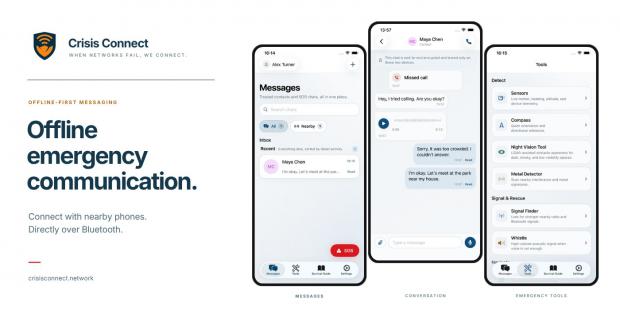
On February 6th, 2023, earthquakes devastated southern Türkiye and northern Syria. When they were needed most, the miracles of modern instantaneous communications were absent as cellular and internet infrastructure was damaged or destroyed.
Seeing that, a high school student hundreds of miles away in Istanbul began to work on a crisis-specific messaging app, one that would work when others wouldn't.
Emirhan Duman took a unique approach. He abandoned cellular signal, satellite connection, or mobile data in favor of shortwave frequencies—perfect for getting a message out of a smashed car or collapsed building. Yet rather than try to sell walkie talkies, he leveraged the most well-known shortrange frequency used today: Bluetooth.
"I've been building Crisis Connect, an open-source project addressing communication outages during disasters, on my own since April 2025," Duman, still only 17, told GNN.
"The idea grew out of the communication outages during the February 2023 earthquakes in Türkiye. The app is designed to help nearby phones exchange messages over Bluetooth when internet access or mobile networks are unavailable."
Writing for a United Nations blog, Durham described Bluetooth as "an untapped communication network sitting in millions of pockets."
Crisis Connect, his ultimate creation, allows users to send messages and calls over Bluetooth when 4G and cellular communications are interrupted by disasters.
The real party trick of the messaging platform is that it can use all shortrange connections in a given area to send a message "hopping" from phone to phone until it reaches the receiver. The phones act as relays, allowing each Crisis Connect-enabled device to pass messages closer and closer to the ultimate address. In this way, a neighborhood or community can help keep everyone in contact with everyone else.
By default, this feature is disabled to save battery life, but in an emergency, it can be switched on not only to help the user connect with family, friends, authorities or rescuers, but also everyone else to connect with whomever they need to reach.
Duman admits freely that by nature this requires forward planning. Crisis Connect can do no good to anyone if they wait for their house to collapse before trying to download the app.
"The design starts before an emergency. Users connect with family members, neighbors or teammates by scanning a QR code or establishing a nearby Bluetooth connection," Duman wrote at Prevention Web, a disaster management platform maintained by the UN Disaster Risk Response program. "Those connections are then designed to keep working when internet and cellular services are unavailable."