







Breaking News
 Fed Governor Admits Policy Reversal as Inflation Proves Stickier Than Hoped
 The Guillotine Was Far More Sinister Than You Think
 Team Arrives at Remote Island in Search of Amelia Earhart's Plane
 Peter Schiff: Trump's Economic Boom is an Illusion
Top Tech News
 I Built a Website to Expose Solar and Battery Scams
 Whistleblower Issues Dire Warning: Rogue AI, Hacking Nuclear Programs...
 Multi-material insulation delivers up to 10,000 x the stiffness
 Anduril's plan to save US sub edge from China's undersea surge
 Researchers Develop AI 'Mind-Reading' Tool That Reconstructs What Your Eyes See
 Video: Dexterous robot hand learns the delicate art of silk embroidery
 The computer that can read your mind:
 Seven apps. One craft
 SHOCK CASE REPORT: Advanced Alzheimer's Patient Regains Speech, Memory, Mobility...
 Most artificial limbs rely on silicone or plastic to mimic human hands.



Meta Building AI Data Centers in Tents and Amazon Building Gigawatts of Power for AI
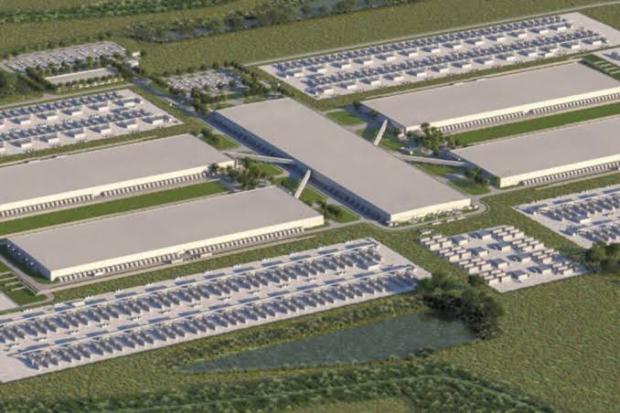
Meta's Prometheus data center in New Albany, Ohio. Meta brought five data center buildings online between 2020 and 2023. They threw the cloud-era data center playbook out the window and began building new AI-optimized buildings. Even more recently, Meta began building tents powered by off-grid gas turbines on the south part of the campus.
As of the end of of August, Epoch.AI, Buildings 7-10 (tents) are operational, based on infrared drone video from RAAD captured on this date. The video suggests that 138.8 MW of nameplate turbine capacity is operating at the Socrates South power plant (about 69% of the 200 MW nameplate capacity), and Buildings 7-10 roof vents are bright on infrared while Buildings 11-12 vents are not. 4 out of 6 buildings operating, implying about 67% of capacity, which is consistent with 69% of the power plant operating. In the north, Buildings 16-27 (tents) look to be in a completed state. Each northern set of 6 tents still awaits to be connected to one of the corresponding power plants to become operational. Drone video from August 19th shows no turbines operating at Socrates North, though there are 3 small diesel generators operating. Building 13 (Vantage) is still under construction, Epoch.ai estimate another 3 months before operability.
When ChatGPT launched and ushered in the generative AI era, Amazon operated 7.4 GW of data center capacity in the US. Amazon has nearly doubled its data center footprint. Amazon has 69% more capacity than the next hyperscaler, Microsoft, and roughly double Google and Meta's capacity.
As of Oct 2026, Cleanview reports are 1341 operating data centers in the US with a combined capacity of 62,942 MW, and 2595 planned projects that would add 385,611 MW of additional capacity.
Meta is building dozens of massive tents at campuses across the US, sticking billions of dollars of chips inside, and powering them with off-grid turbines. The AI race has officially entered its Mad Max phase. Over the last month, I reviewed hundreds of documents and satellite images for Cleanview's latest report on behind-the-meter data centers. Meta's data center strategy, which is very visible from space, was one of the weirder approaches I came across. Mark Zuckerberg recently ditched the data center designs that Meta had perfected over the last decade and told his team to stick tens of thousands of chips in tents outside their data center in New Albany, Ohio. Each of these chips costs about $60,000. Zuckerberg plans to stick billions of dollars worth of them in the tents. The strategy has helped cut the time to build compute in half. The first five buildings at Meta's New Albany, Ohio data center took between two and three years to build. Meta started building five ~125,000 square foot tents between April and June of 2026, according to city permits. Satellite images show the structures have all been built. To power those "rapid deployment structures", as they are officially named, Meta signed a 10-year deal with Williams to build a pair of 200 MW off-grid power plants. Those power plants began construction about a year ago and are nearly complete. Meta is using the same strategy to build a data center in Tennessee, bringing the total count of tent data centers to three. Strategies like this are part of the reason behind-the-meter data center capacity is growing so quickly. In Cleanview's report, I found that there's currently about 2 GW of BTM capacity online today. By the end of the year, it will likely be 3 GW—equivalent to three nuclear power plants. By the end of 2027, it could be as high as 13 GW—more than the power demand of NYC. I've been talking to a lot of reporters about this research. When I told one reporter about these tents and other companies powering their data centers with jet engines, he said, "It's like a scene out of the movie Mad Max."
— Michael Thomas (@curious_founder) June 4, 2026