










Breaking News
 #689: The Empire of Lies | Charles Goyette
 One Arizona storm; 15 rain totes
 Teach AI Good Morality
 Guilfoyle Resigns at Trump's Request Following Credit Card Scandal
Top Tech News
 I Built a Website to Expose Solar and Battery Scams
 Whistleblower Issues Dire Warning: Rogue AI, Hacking Nuclear Programs...
 Multi-material insulation delivers up to 10,000 x the stiffness
 Anduril's plan to save US sub edge from China's undersea surge
 Researchers Develop AI 'Mind-Reading' Tool That Reconstructs What Your Eyes See
 Video: Dexterous robot hand learns the delicate art of silk embroidery
 The computer that can read your mind:
 Seven apps. One craft
 SHOCK CASE REPORT: Advanced Alzheimer's Patient Regains Speech, Memory, Mobility...
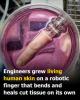 Most artificial limbs rely on silicone or plastic to mimic human hands.


Regarding the Claim That "Viruses Don't Exist!"

Author's Note: I initially wrote the following essay about 18 months ago. Recent reader comments inspired me to repost it with a few modifications.
When I was studying philosophy in graduate school, my favorite class was epistemology, or how we know what we think we know.
As philosophers from Aristotle to Wittgenstein have observed, "knowing" something to be true isn't as easy to establish as we often assume it to be. A famous example of how hard it can be to nail down the reality of the physical world was the longstanding argument between Albert Einstein and Niehls Bohr whether quantum mechanics is a complete account of physical reality, or only an incomplete statistical tool. To this day, their argument has never been entirely resolved, though the weight of opinion has shifted to favoring Bohr's intepretation.
The uncertainty of things is especially true in the realm of so-called "medical science." Many make the unexamined assumption that "medical science" is akin to Newtonian mechanics, but this is a gross misconception. The causes of sickness and health—both in individuals and in large populations—are far more complex and multifactorial than than the behavior of solid bodies moving in space.
Consider that while reasonable people often debate about health and disease, none would debate about whether jumping off twenty-story building onto concrete would result in severe injury or death. A complex situation is inevitably riddled with ambiguity and uncertain outcomes and therefore becomes a subject of opposing interpretations and debate.