










Breaking News
 MTG, Tucker Carlson, Thomas Massie Spark New Third Party Speculation
 BOMBSHELL: Deep State Ran a Criminal Conspiracy to Frame Trump as a Russian Asset...
 Mike Rowe Just Took a Wrecking Ball to the DSA – and the Democrats Screaming About It Only...
 IT WENT NUCLEAR
Top Tech News
 Voyager 1 approaches one light day from Earth
 Visual Implants
 Renewable Energy Breakthrough! World's Most Efficient Tesla Turbine System
 I Told You So
 Meet Sunbird, a nuclear fusion-powered space tug concept from Pulsar Fusion.
 China and Russia launch 29-nation AI alliance to rival western control of technology
 BREAKING: China has begun manufacturing domestically developed Immersion Deep...
 Idaho's High Desert Becomes Hot Spot For Nuclear Power Revolution
 The World's Largest Electric Aircraft Is About to Take Its First Flight
 Tesla Cybercabs and Superchargers Will Act as Mini Cell Towers for SpaceX Starlink



The Coming Precious Metals Shock Could Reshape the Global Economy
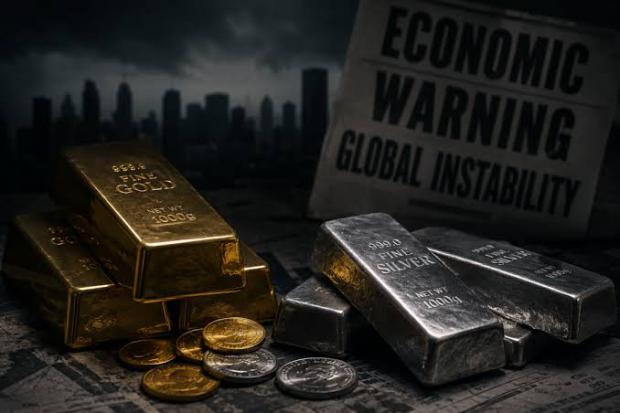
Gold, according to that narrative, had already enjoyed its moment. Silver, despite its indispensable role in modern industry, was expected to settle back into a familiar cycle of moderate demand and predictable pricing. Instead, 2026 has produced a far more unsettling reality. Gold has repeatedly demonstrated that even record-breaking prices have not been sufficient to discourage institutional accumulation, while silver continues to face a structural supply deficit for the sixth consecutive year—a situation that is becoming increasingly difficult for manufacturers, traders, and policymakers to dismiss as a temporary imbalance. These are no longer isolated developments confined to commodity exchanges; they are signals of a financial environment in which confidence itself is quietly becoming a contested asset.
What makes this moment particularly uncomfortable is not the spectacular rise in precious metals alone. Markets have always experienced dramatic rallies before eventually correcting. The more important question is why demand has remained remarkably resilient despite conditions that, historically, should have weakened it. Interest rates in many developed economies remain elevated compared with the previous decade. Economic growth forecasts have been revised lower across several major regions. Consumer spending is beginning to show signs of fatigue, while businesses continue navigating higher financing costs, geopolitical uncertainty, and increasingly fragmented trade relationships. Under such circumstances, conventional economic models would normally predict softer investment flows into defensive assets. Yet central banks continue adding gold to their reserves, institutional investors remain reluctant to reduce strategic allocations, and physical demand continues to absorb supply at levels that suggest something more profound than routine portfolio diversification.
Perhaps the most revealing aspect of this story is that it is unfolding almost entirely outside the headlines dominating mainstream financial news. Artificial intelligence, equity valuations, political campaigns, and quarterly earnings reports continue attracting the overwhelming share of public attention, while the foundations supporting the global monetary system are shifting with surprisingly little discussion. The world's central banks have spent years gradually increasing their gold holdings, motivated not by nostalgia for the gold standard but by a growing desire to diversify away from geopolitical risk, currency uncertainty, and an increasingly fragmented international financial order. At the same time, industrial demand for silver has accelerated well beyond its traditional role as a precious metal. Every expansion of solar manufacturing, every investment in advanced electronics, data infrastructure, electric vehicles, power grids, and next-generation semiconductor technologies quietly increases dependence on a resource whose supply has struggled to keep pace with consumption.