










Breaking News
 The AI Bird-Flu Scenario They Just Published
 Japan's first robot ambulance works the 9-1-1 lines for humanoids
 Cheap smartphone add-on pinpoints hidden cameras to shut down spies
 The $600 Tank That Beats a $10,000 Powerwall
Top Tech News
 Terrifying AI Behavior Even Its Creators Couldn't Explain
 WW3 Near-Miss? AI Hallucinated Nuclear Weapons Components Aboard Chinese Vessel Bound For Iran
 Stripe Is Building the Toll Road for the Machine Economy
 Toyota Dakar hopeful swaps twin-turbo V6 for hydrogen fuel cells
 4-min turbo-inflatable cubic camp castle is now available in the USA
 Researchers Used Claude To Hack OpenAI Employee Accounts
 Chinese Scientists Develop New Oil Refining Method That Cuts Energy Use by 90%
 World's smallest CT scanner fits in the palm of your hand
 The Tesla Roadster will blow people's minds
 Peter Thiel-Funded Company Anduril to Triple the Number of Autonomous Surveillance Towers...



Mini quantum battery charges a million times faster than it discharges
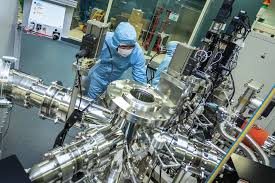
Or perhaps, EVs gaining 60 miles worth of charge in under an hour? Scientists have created a proof-of-concept quantum battery that charges one million times faster than it discharges … using a laser.
For many years, the concept of a quantum battery, which uses the principles of quantum mechanics to store energy, has remained theoretical, largely due to the complexities and unpredictability of quantum technology.
In a significant leap forward for the field, a group of researchers comprising scientists from the Australian Space Agency, CSIRO, RMIT University, and the University of Melbourne has created the world's first proof-of-concept quantum battery, charged wirelessly with a laser.
The new prototype, still very far from being practical, took femtoseconds (quadrillionths of a second) to charge and stored the energy for nanoseconds. Technically speaking, the battery lasted one million times longer than it took to charge. To put that into perspective, that's like a phone taking 30 minutes to charge fully and then lasting for over 100 years. Another illustration is an 11-day-lasting battery that charges in one second.
"It's the first prototype which does a full cycle of a battery: in other words, you charge it, you store energy, and you can discharge it," says lead researcher Dr. James Quach of CSIRO.
Before we get carried away, it's important to note that this is the very earliest stage of the technology. The current prototype has a capacity of only a few billion electron volts, barely enough to power anything. It sounds large, but 5 billion electron volts is about 1/200,000th of the energy of a flying mosquito.
Still, it is very welcome proof that the concept works, marking a significant breakthrough for the future of quantum energy storage.
"The research and proof-of-concept validates the exciting potential of quantum batteries to achieve rapid, scalable charging and energy storage at room temperature, laying the groundwork for next-gen energy solutions," Dr. Quach says.
In contrast to conventional batteries that primarily rely on chemical reactions to store and discharge energy, quantum batteries leverage unique quantum-mechanical properties, such as superposition and entanglement.
"The advantage of quantum is that the system absorbs light in a single, giant 'super absorption' event and this charges the battery faster," explains Associate Professor James A. Hutchison, key contributor in the research.
To the untrained mind, quantum technology can seem all fuzzy and weird. But to trained minds, it's all … pretty much the same. As with all things quantum technology, the researchers' prototype exhibited some "strange" characteristics. In standard batteries, size is directly proportional to charging time. Small smartphone batteries fully charge in hours, while their much larger EV counterparts take overnight to charge. Quantum batteries do the exact opposite.