










Breaking News
 Episode 470: A FOOD CRISIS, AUTISM COMMUNICATION RIGHTS, AND STEM CELL...
 A Case For Jesus Christ - Lee Strobel | PBD #770
 Situation with the war has finally made me use fuel stabilizer for my diesel fuel.
 Could the War Trigger a Financial Reset & Usher in a CBDC Beast System? w/ Micah Haince
Top Tech News
 DARPA O-Circuit program wants drones that can smell danger...
 Practical Smell-O-Vision could soon be coming to a VR headset near you
 ICYMI - RAI introduces its new prototype "Roadrunner," a 33 lb bipedal wheeled robot.
 Pulsar Fusion Ignites Plasma in Nuclear Rocket Test
 Details of the NASA Moonbase Plans Include a Fifteen Ton Lunar Rover
 THIS is the Biggest Thing Since CGI
 BACK TO THE MOON: Crewed Lunar Mission Artemis II Confirmed for Wednesday...
 The Secret Spy Tech Inside Every Credit Card
 Red light therapy boosts retinal health in early macular degeneration
 Hydrogen-powered business jet edges closer to certification


The Faulty Premise
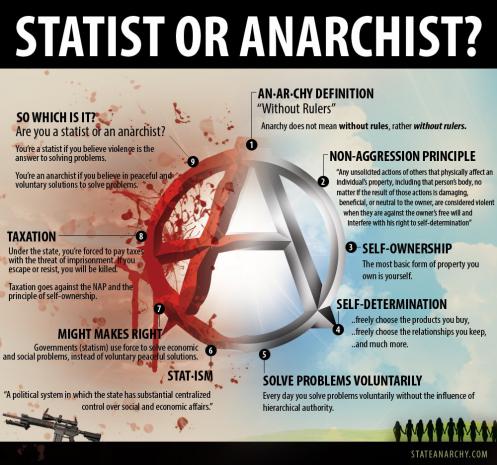
But would it be so, in fact?
Given how evil we know government is, in fact, perhaps it's worth looking into what anarchy might be – and whether it might be less of an evil than government.
First, though, we ought to be clear about the things we're discussing.
What doe we mean by government? It is fundamentally the sole authority that legally controls an area (and the people within that area) via coercion.
The italics are used to emphasize two important things – relative to anarchy.
Government decides the extent of its own authority. There is no other (legal) authority to counterbalance the self-described authority of government. Jefferson and Madison tried to limit government not only by attempting to restrict it to enumerated (that is, specifically described) powers but also by creating a tiered – or federalized – system that would give some appeal contra authority within the structure of the authority itself. The House would balance the Senate and both would balance the Executive. Jefferson and Madison also articulated one further appeal – also still within the system. The states could nullify what the federal government decreed by ignoring what the federal government decreed or by refusing to enforce or allow its enforcement within the boundaries of the objecting states.
There was, of course, a more effective – and final – appeal that was ended by Abraham Lincoln. That of secession. It is a word that became a dirty word – on account of the outcome of that war, the victors always determining how the war is viewed by posterity. They made "secession" synonymous with rebellion – as if that were necessarily a bad thing. It is not generally considered a bad thing with regard to what the American colonists (some of them) did with regard to Great Britain but it became a very bad thing indeed, when their descendants attempted precisely the same four score and seven years later. Since then, the idea of rebellion has carried with it an inculcated smack of unwarranted defiance; i.e., it is taken as fundamentally (always) wrong to "rebel" against the authority of the government. That is, to reject its authority as illegitimate and thus, evil.
This gets us back to anarchy.
What doe we mean by this term?