










Breaking News
 Rising Prices and Falling Values--Inflation and Social Decay
 The non-Zionist Israeli Population Could Save the Day
 AfD Launches 'Knife App' As Berlin Violence Surges
 Oil Prices EXPLODE After Trump Signals That US Is Moving To Wartime Economy
Top Tech News
 DARPA O-Circuit program wants drones that can smell danger...
 Practical Smell-O-Vision could soon be coming to a VR headset near you
 ICYMI - RAI introduces its new prototype "Roadrunner," a 33 lb bipedal wheeled robot.
 Pulsar Fusion Ignites Plasma in Nuclear Rocket Test
 Details of the NASA Moonbase Plans Include a Fifteen Ton Lunar Rover
 THIS is the Biggest Thing Since CGI
 BACK TO THE MOON: Crewed Lunar Mission Artemis II Confirmed for Wednesday...
 The Secret Spy Tech Inside Every Credit Card
 Red light therapy boosts retinal health in early macular degeneration
 Hydrogen-powered business jet edges closer to certification


Ever Wonder Where $7 Trillion Goes?
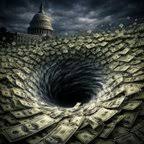
It points out that the United States has never entered an economic downturn as indebted as it is today— meaning there is essentially zero fiscal space to respond to the next crisis.
When the financial crisis hit in 2008, national debt stood at roughly 35% of GDP. By the time it was over, debt had ballooned to about 70%.
Then, when COVID hit in 2020, debt was already at 80% of GDP. By the time that was over, it had surged past 100%.
Today the official national debt is almost at 130% of GDP. That's well beyond the World War II record.
Each economic crisis starts from a worse position, requires more borrowing, and leaves the country deeper in the hole.
None of this should be surprising to anyone who's been paying attention. We've been writing about this for years.
We said it in 2019 when everything was going great— record stock market, record tax revenue, healthy economy— and the government still ran a trillion dollar deficit.
We wondered out loud— if the government still runs a $1 trillion deficit when everything is great, how bad will the deficit be when there's an actual crisis?