










Breaking News
What's the Point of Rocketing to the Moon and Mars?
 Apple FORCES iPhone Users To Prove Age With ID Or Lose Unrestricted Internet Access
 Iran War Silver Lining: NATO's Death Knell?
 US Retail Sales Jumped Most In 8 Months In February
Top Tech News
 DARPA O-Circuit program wants drones that can smell danger...
 Practical Smell-O-Vision could soon be coming to a VR headset near you
 ICYMI - RAI introduces its new prototype "Roadrunner," a 33 lb bipedal wheeled robot.
 Pulsar Fusion Ignites Plasma in Nuclear Rocket Test
 Details of the NASA Moonbase Plans Include a Fifteen Ton Lunar Rover
 THIS is the Biggest Thing Since CGI
 BACK TO THE MOON: Crewed Lunar Mission Artemis II Confirmed for Wednesday...
 The Secret Spy Tech Inside Every Credit Card
 Red light therapy boosts retinal health in early macular degeneration
 Hydrogen-powered business jet edges closer to certification


Gearing Up For Artemis II: NASA's High-Stakes Test Run Around the Moon
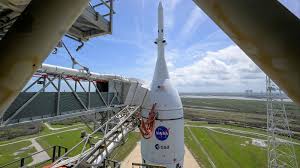
Four astronauts will take a roughly 10-day trip that loops around the moon and comes straight back, with no orbiting or moonwalks.
The crew—Reid Wiseman, Victor Glover, Christina Koch, and Jeremy Hansen—marks a few firsts: the first woman, first person of color, and first non-American assigned to a lunar mission. Koch already holds the record for the longest single spaceflight by a woman, while Glover previously made history aboard the International Space Station. Hansen, representing Canada, is the only rookie in the group.
They'll launch aboard NASA's massive Space Launch System rocket, with the Orion capsule on top. After liftoff, the plan is to spend about a day in an elongated orbit around Earth, practicing navigation by flying close to a spent rocket stage—without docking, just eyeballing the distance. As commander Wiseman put it, "Sometimes simple stuff is the best."
KSL writes that from there, Orion will fire its engine and send the crew on a long arc toward the moon, roughly 244,000 miles away. Using a "free-return" trajectory—basically letting gravity do most of the work—they'll swing around the far side and travel about 5,000 miles beyond it, farther than any humans have gone before. The moon will loom large during the flyby, and the crew is expected to document rarely seen regions of its far side.
After about six days, they'll slingshot back toward Earth, wrapping up the mission with a Pacific Ocean splashdown just under 10 days after launch. Engineers will be paying close attention to Orion's heat shield during reentry, since it took heavy damage during an earlier uncrewed test.
The mission hasn't been perfectly smooth so far—fueling issues like hydrogen leaks have already caused delays—but Artemis II is still a crucial step. NASA ultimately wants to return astronauts to the lunar surface, and this flight is meant to prove they can get there—and back—safely.