










Breaking News
 ISIS Attacker Killed by ROTC Students + GDP Crashes to 0.7% + Senate Bans the Digital Dollar
 The Case for Gold: Why It Matters Now | Philip Patrick
 "This will change HUMANITY!" Intel agencies using nanotech to control our thoughts
 Doomed to Fail: Washington Lawmakers Don't Understand 3D Printing
Top Tech News
 Musk Whips Out 'Macrohard' In Disruptive Tesla-xAI Bid To Shaft Software Companies
 This Bonkers Folding X-Plane Is One Step Closer to Hitting the Skies
 Smart 2-in-1 digital microscope goes desktop or handheld as needed
 Human Brain Cells Merge With Silica To Play DOOM
 Will Yann LeCun Provide The Next Breakthrough In AI?
 Human Brain Cells Merge With Silica To Play DOOM
 Solar And Storage Could Reshape Rural Electricity Markets
 With World Seemingly At War, DARPA Finds Time To Unveil The X-76
 Renewable Water From Air.
 The world's first diesel plug-in hybrid pickup truck is here



Ambitious startup plans to put AI data centers in offshore wind turbines
One of the biggest concerns in AI is the enormous amount of energy it requires. In 2025 alone, AI data centers consumed 448 TWh of electricity, roughly equivalent to Germany's annual electricity consumption. Industry analysts project this number could double in just five years.
These levels of consumption place severe strain on local grids and raise pertinent questions about AI sustainability, especially now that the world is accelerating its transition to clean energy.
Researchers and engineers are racing to develop sustainable solutions that reduce AI data centers' reliance on the grid. This usually means generating clean energy on-site. However, even these efforts are meeting resistance. The rate at which data centers are popping up across the US and Europe is driving not-in-my-backyard sentiment towards both the facilities themselves and the energy infrastructure needed to power them. Communities are concerned about land use, energy consumption, and environmental impact.
Aikido Technologies, a San Francisco-based company, may have found a way to solve both problems at once by moving the entire operation out to sea.
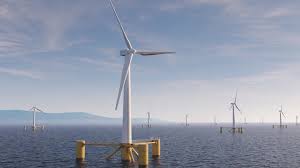
The startup, best known for developing floating offshore wind platforms, has proposed a concept called the AO60DC, which integrates a large offshore wind turbine, battery storage, and a modular data center into a single structure. Basically, a wind-turbine/data-center hybrid. Instead of building server farms on land and running long transmission lines from distant wind farms, Aikido's design places computing infrastructure directly at the source of renewable energy, colocating power generation, computing, cooling, and energy storage on a single floating platform.
"Over the past year, as we watched the growing challenges around powering and cooling new data centers, we realized our platform already had ample power and effectively free cooling built in. It hit us like a ton of bricks," said the CEO of Aikido, Sam Kanner.
The platform resembles a floating offshore wind foundation with three large structural legs. Inside those legs are sealed data-center modules housing racks of servers. The wind turbine mounted atop generates electricity that powers the computing systems below, while the surrounding seawater cools them.
Overall, the concept itself is elegantly straightforward. However, the actual engineering behind it all is anything but.
The system consists of a large platform that supports the turbine in the center, with three legs extending out from the base of the tower. The end of each leg contains a ballast that extends to around 20 meters (65 ft) deep. These ballasts hold tanks that are mostly filled with fresh water to keep the platform afloat at a given height, but the upper part of each tank also contains a 3- to 4-megawatt data hall.