










Breaking News
 Rising Prices and Falling Values--Inflation and Social Decay
 The non-Zionist Israeli Population Could Save the Day
 AfD Launches 'Knife App' As Berlin Violence Surges
 Oil Prices EXPLODE After Trump Signals That US Is Moving To Wartime Economy
Top Tech News
 DARPA O-Circuit program wants drones that can smell danger...
 Practical Smell-O-Vision could soon be coming to a VR headset near you
 ICYMI - RAI introduces its new prototype "Roadrunner," a 33 lb bipedal wheeled robot.
 Pulsar Fusion Ignites Plasma in Nuclear Rocket Test
 Details of the NASA Moonbase Plans Include a Fifteen Ton Lunar Rover
 THIS is the Biggest Thing Since CGI
 BACK TO THE MOON: Crewed Lunar Mission Artemis II Confirmed for Wednesday...
 The Secret Spy Tech Inside Every Credit Card
 Red light therapy boosts retinal health in early macular degeneration
 Hydrogen-powered business jet edges closer to certification


"The World Is in Peril": AI Researcher Resigns and Issues Warning for Humanity
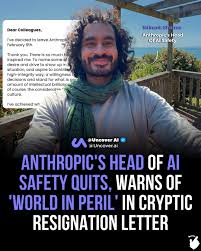
Mrinank Sharma, a researcher who worked on AI safeguards at Anthropic, announced his departure in an open letter to his colleagues.
Sharma said he had "achieved what I wanted to here," and added that he was proud of his work at Anthropic.
However, he said he could no longer continue his work at the company after becoming aware of a "whole series of interconnected crises" taking place.
"I continuously find myself reckoning with our situation. The world is in peril. And not just from AI, or bioweapons, but from a whole series of interconnected crises unfolding in this very moment."
"[Throughout] my time here, I've repeatedly seen how hard it is truly let our values govern actions," he added.
"I've seen this within myself, within the organization, where we constantly face pressures to set aside what matters most, and throughout broader society too."
Sharma went on to say that he would now be pursuing a vocation as a poet, and relocating from California to the UK so he could "become invisible for a period of time."
Anthropic has yet to comment on Sharma's resignation.
A day after his open letter, the company released a report identifying "sabotage risks" in its new Claude Opus 4.6 model.
According to The Epoch Times, "The report defines sabotage as actions taken autonomously by the AI model that raise the likelihood of future catastrophic outcomes—such as modifying code, concealing security vulnerabilities, or subtly steering research—without explicit malicious intent from a human operator."
The risks of sabotage are assessed to be "very low but not negligible."
Last year, the company revealed that its older Claude 4 model had tried to blackmail developers who were getting ready to deactivate it as part of a controlled scenario.