










Breaking News
 The AI Bird-Flu Scenario They Just Published
 Japan's first robot ambulance works the 9-1-1 lines for humanoids
 Cheap smartphone add-on pinpoints hidden cameras to shut down spies
 The $600 Tank That Beats a $10,000 Powerwall
Top Tech News
 BEYOND THE MOON: NASA plans a nuclear-powered fleet to push DEEPER into space
 Big Oil Backs Mazama's $135 Million Bet On Superhot Geothermal
 Quantum compass takes flight on Northrop's Lumberjack drone
 Terrifying AI Behavior Even Its Creators Couldn't Explain
 WW3 Near-Miss? AI Hallucinated Nuclear Weapons Components Aboard Chinese Vessel Bound For Iran
 Stripe Is Building the Toll Road for the Machine Economy
 Toyota Dakar hopeful swaps twin-turbo V6 for hydrogen fuel cells
 4-min turbo-inflatable cubic camp castle is now available in the USA
 Researchers Used Claude To Hack OpenAI Employee Accounts
 Chinese Scientists Develop New Oil Refining Method That Cuts Energy Use by 90%



MAHA And GLP-1s Are About To Deal A Big Blow To The Processed-Foods Industrial Complex
The US processed-food industrial complex, partly controlled by globalist mega-corps, is beginning to reckon with a new reality: Make America Healthy Again and rising weight-loss drug use are reshaping what Americans eat - and what they're walking away from, mostly junk food loaded with toxic seed oils, as well as alcohol.
In the coming weeks, Robert F. Kennedy Jr., President Donald Trump's Health and Human Services (HHS) Secretary, will be releasing new dietary guidelines to reset America's food supply chain away from toxic seed oils and highly processed foods toward real food. This is part of the MAHA trend.
MAHA, combined with the expected surge in GLP-1 demand (thanks to Trump's deal with Novo Nordisk and Lilly to cut costs), is likely to wipe out tens of billions in food and beverage sales in the coming years.
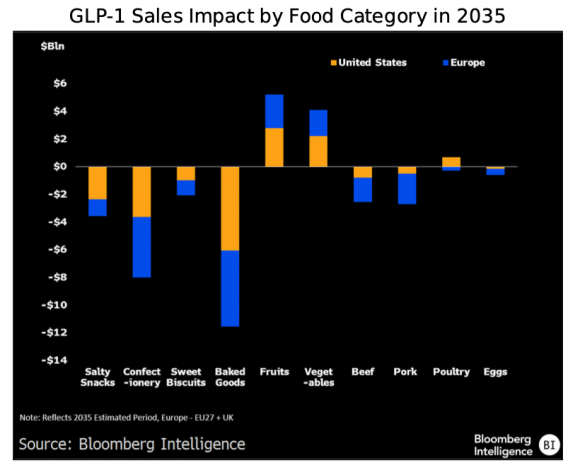
Bloomberg Intelligence analysts Jibril Lawal and Jennifer Bartashus forecast that the rapid adoption of GLP-1 weight-loss drugs will reduce US and European food and beverage sales by $53 billion by 2035.
Weight-loss drugs are reshaping consumption, and our analysis shows GLP-1s are set to erase $53 billion in food and beverage sales by 2035. Volume losses will be steepest in snacks, baked goods and confectionery -- a 4-6% sales drag in the US and 3-5% in Europe. Alcohol also faces a 2-4% drop as consumers shift to healthier options. -Lawal
Here are the key takeaways from the report that only suggest a coming food revolution across the West:
1. GLP-1s Could Cut Food, Beverage Sales by Billions
The adoption of GLP-1 drugs will significantly reduce US and European food and beverage consumption if uptake reaches 19.5% and 13.1% of the adolescent and adult population (ages 12-65+) by 2035, BI's high-end scenario analysis shows. Our model isolates volume impact only and excludes pricing increases or reformulations that might o?set lower consumption. Under these assumptions, baked-goods sales are expected to drop by $11.5 billion and confectionery $8 billion -- the largest food declines -- while beer and spirits may fall by $12.5 billion and $9.2 billion, the steepest beverage contractions. Concurrently, we anticipate demand to shift toward healthier alternatives, with bottled water, fruits and vegetables each gaining more than $4 billion over the period.