










Breaking News
 'UNFAIR': Mamdani's city-run grocer plan SLAPPED with lawsuit
 Trump Says If Iran Had a Nuclear Weapon, He Would Have Politely Called the Supreme Leader...
 Tucker Carlson: We are on the brink of a world war that ends with the use of nuclear weapons
 Who is trying to destroy the United States and the world?
Top Tech News
 Freezable titanium plate keeps your cooler chilled way longer than ice packs
 Review: Affordable thermal device is made for discovering life outdoors
 AI Whistleblower Tells Tucker How AI Could Kill All Humans by 2040
 You Hate Flock? Well There's More...
 Will Spiking Diesel Prices Drive Autonomous Trucking?
 Chinese Concept Video Imagines the Future of Warfare
 OPTIMUS CONFIRMED: 15,000 Bots This Year -- Tesla to $3,000
 What is Going On With Robotaxi and Cybercab? Here Are All the Answers
 Floating data center would provide water and electricity to 32,000 homes
 OpenAI Cuts Off Elon's Cursor, Humanity's First Star Probe, and Trump's Nuclear Mars Shi



Yamaha's world-first hydrogen outboard unveiled on prototype boat
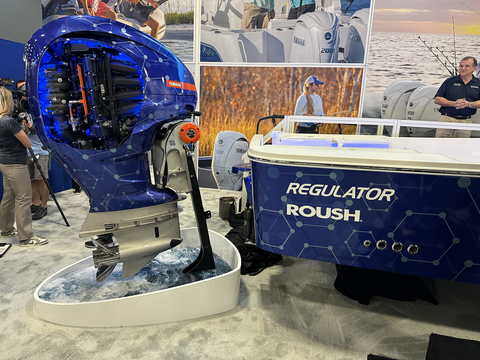
Yamaha calls its new hydrogen V8 outboard a world first for the recreational boating industry and has partnered up with Roush and Regulator Marine to install it into a working boat that will begin testing in a few months.
In developing its hydrogen outboard prototype, Yamaha adapted the technology it has used for land-based hydrogen combustion engines, including the one it installed on the Drive H2 golf cart concept revealed last month at the PGA Show. In this case, it created a hydrogen version of its flagship XTO outboard, an offshore V8 offering 425- and 450-hp ratings, the most powerful in Yamaha's outboard lineup. Yamaha has not released output specs for the hydrogen version, so we're not sure how close it comes to joining the gas XTO at the top of the Yamaha outboard family.
Building a combustion engine that can run on hydrogen is but one part of the equation; another major challenge is figuring out how to store and run the H2 to fuel it. For this aspect of the project, Yamaha turned to the experts at Roush for help.
The Roush name rings familiar to us primarily from its performance automotive division and Ford Mustang models and components, but the greater company includes engineering and clean tech arms that work in a wide variety of industries, from mobility and aerospace, to energy and defense. It has decades of experience working with hydrogen power systems across various sectors.
"When you look at Roush's history with hydrogen, it ranges from land speed record vehicles to spacecraft," explains Matt Van Benschoten, vice president of advanced engineering at Roush. "A lot of that knowledge we've acquired over the years, we are now applying directly to this Yamaha project. We are the fuel systems integrator, responsible for fuel systems designs, all of the specifications development, physical integration, safety system analysis, as well as testing and development. Yamaha is trying to determine if hydrogen can successfully be used in this market, and I think we will find out the answer is 'yes.'"