










Breaking News
 This is the future we shall bring into being
 Elon Musk's Vision For The Future Looks Like A Movie
 Phosphorus Munitions Fired by Israel Burn Groves, Orchards in Southern Lebanon
 Iran's IRGC Warns It Will Expand 'Geography of the War' If the US Attacks Again
Top Tech News
 BEYOND THE MOON: NASA plans a nuclear-powered fleet to push DEEPER into space
 Big Oil Backs Mazama's $135 Million Bet On Superhot Geothermal
 Quantum compass takes flight on Northrop's Lumberjack drone
 Terrifying AI Behavior Even Its Creators Couldn't Explain
 WW3 Near-Miss? AI Hallucinated Nuclear Weapons Components Aboard Chinese Vessel Bound For Iran
 Stripe Is Building the Toll Road for the Machine Economy
 Toyota Dakar hopeful swaps twin-turbo V6 for hydrogen fuel cells
 4-min turbo-inflatable cubic camp castle is now available in the USA
 Researchers Used Claude To Hack OpenAI Employee Accounts
 Chinese Scientists Develop New Oil Refining Method That Cuts Energy Use by 90%



Li-ion co-inventor patents glass battery that could upturn auto industry
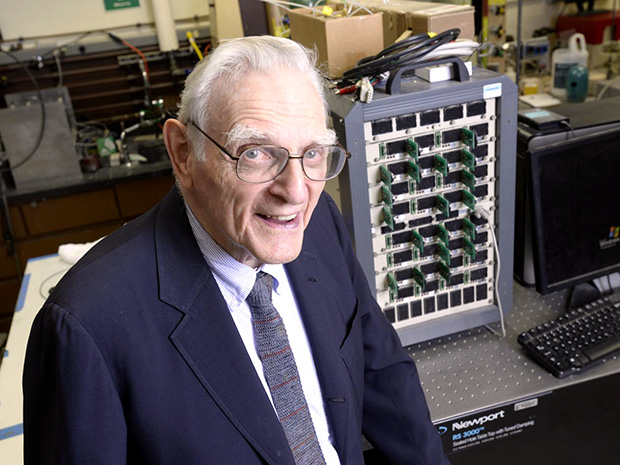
A patent application for a new battery that uses glass as a key component has been submitted by a team headed by John Goodenough, the part winner of the 2019 Nobel Prize in Chemistry for his work as co-inventor of the now ubiquitous lithium-ion battery that is the go-to power source for electric cars and energy storage.
And the new glass battery promises to accelerate the shift away from internal combustion engines because it will deliver a significant increase in storage capacity.
By "spiking" glass with either sodium or lithium to form an electrode within the battery, the researchers say the new battery technology provides three times the energy storage capacity of comparable lithium-ion batteries.
It is also neither volatile nor flammable, and does not display issues of lithium dendrite growth that plagues li-ion batteries, which can cause short-circuits and present safety hazards.
First described in a 2016 paper published in Energy and Environmental Science, and now in a patent application activated on Sunday on behalf of the LNEG (National Laboratory of Energy and Geology) in Portugal, the University of Porto, Portugal and the University of Texas, the new glass battery electrode has the potential to upturn the transport industry.
That is, if it is commercialised. But according to Goodenough, who spoke with IEEE's Spectrum magazine about the technology, the glass battery could finally break through the price barrier that hinders the uptake of electric cars.
"I think we have the possibility of doing what we've been trying to do for the last 20 years," Goodenough, who is emeritus professor at the Cockrell School of Engineering at the University of Texas, Austin, told Spectrum.
"That is, to get an electric car that will be competitive in cost and convenience with the internal combustion engine."
It could also be used to store intermittent solar and wind power on the electric grid, Goodenough tells Spectrum.
Fellow researcher Maria Helena Braga from the University of Texas, Austin says that early testing also suggests could also have "perhaps thousands" of charge and discharge cycles, more than the average 1,000-2,000 cycles achievable in typical nickel-manganese-cobalt or lithium iron phosphate batteries.
Addtionally, the glass battery electrode has shown it can withstand a wider range of temperatures – between -20º C and 60º C.
"Rechargeable batteries containing a water-solvated glass/amorphous solid electrolyte described herein can provide a safe, low-cost stationary battery capable of storing a large amount of electrical energy for feeding the grid or charging the battery or capacitor of an electric vehicle since the temperature range of operation of a stationary battery can be kept small through all seasons at little cost," reads the patent.