










Breaking News
 "Begin Preparing Yourself..." - Jeffrey Sachs
 The 5-Year Treasury Just Broke 5%... The Whole Curve Is Next
 ICE Denounced for Enacting 'Official Government Policy of Disappearing People'
 Google Just Told Canadian Adults: Give Us Your ID and a Selfie Or Else…And It's Starting Now!!
Top Tech News
 Tesla Model 3 killer charges from 10 to 97% in just 9 minutes
 World-first unpowered DNA computer sets speed record
 I Power 5 Buildings Off-Grid. Here's How
 The US government is pushing hard to get a working nuclear fission reactor into space by late 2028
 SpaceX Starmind AI in Space Radiator
 China Will Dominate Global Nuclear Energy Through 2035, Analyst Says
 These Absolutely Wild-Looking EVs Are Saudi Arabia's First Homegrown Cars
 BEYOND THE MOON: NASA plans a nuclear-powered fleet to push DEEPER into space
 Big Oil Backs Mazama's $135 Million Bet On Superhot Geothermal
 Quantum compass takes flight on Northrop's Lumberjack drone


Hybrid aqueous battery charges up in under 30 seconds
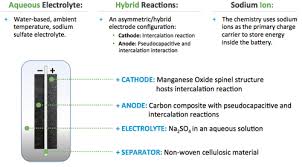
We're so used to having our everyday devices powered by lithium-ion batteries that sometimes it's hard to imagine using anything else. But there are plenty of teams working on alternatives like lithium-air, sodium-ion, lithium-metal and aluminum-ion designs that may help solve some of the drawbacks of lithium-ion batteries. The latest, an aqueous hybrid capacitor, is stable, safe and boasts high energy and power densities, recharging in as little as 20 seconds.
The new creation, out of the Korean Advanced Institute of Science and Technology (KAIST), is made with a liquid electrolyte sandwiched between a specially-designed anode and cathode. The anode is made with polymer chain materials based on graphene, which gives it a high surface area, allowing it to store more energy. The cathode material was made up of nickel oxide nanoparticles embedded on graphene.
Thanks to these materials arranged in these structures, the new device had much higher energy density and faster energy exchange than other aqueous batteries. It was far more stable with minimal energy loss, maintaining its capacity at close to 100 percent over 100,000 redox cycles.

The new device also has a power density about 100 times higher than similar designs, allowing it to be charged in 20 to 30 seconds using low-power systems like a conventional USB charger. In tests, the team hooked two of the batteries up to a flexible photovoltaic cell, and was able to power an LED, while the whole kit was worn like a sleeve.