










Breaking News
 This is the future we shall bring into being
 Elon Musk's Vision For The Future Looks Like A Movie
 Phosphorus Munitions Fired by Israel Burn Groves, Orchards in Southern Lebanon
 Iran's IRGC Warns It Will Expand 'Geography of the War' If the US Attacks Again
Top Tech News
 BEYOND THE MOON: NASA plans a nuclear-powered fleet to push DEEPER into space
 Big Oil Backs Mazama's $135 Million Bet On Superhot Geothermal
 Quantum compass takes flight on Northrop's Lumberjack drone
 Terrifying AI Behavior Even Its Creators Couldn't Explain
 WW3 Near-Miss? AI Hallucinated Nuclear Weapons Components Aboard Chinese Vessel Bound For Iran
 Stripe Is Building the Toll Road for the Machine Economy
 Toyota Dakar hopeful swaps twin-turbo V6 for hydrogen fuel cells
 4-min turbo-inflatable cubic camp castle is now available in the USA
 Researchers Used Claude To Hack OpenAI Employee Accounts
 Chinese Scientists Develop New Oil Refining Method That Cuts Energy Use by 90%



How 3D printing is disrupting the architecture and design industry
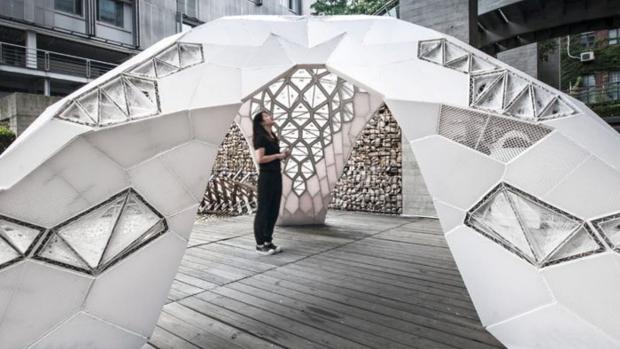
Some consider it the beginning of the third industrial revolution, while others point out the constraints of the technique. Is 3D printing changing our architecture, and is it the way we'll design our homes in the future? Below, we look at the phenomenon of 3D printing worldwide, including a delicate resin pavilion in China, classical-design-inspired concrete beams in Italy and buildings that "think" in Germany.
The technology of 3D printing was invented by Chuck Hull, an American engineer. He initially called the new process stereolithography and patented it in 1986. The technique links molecules using laser light to form polymers into solid shapes.
Initially, industries such as automotive manufacturing used the technology for what became known as rapid prototyping. The advantage was that no molds were required and there was no waste, unlike in milling, where a shape is cut and the material around it is discarded. In 3D printing, objects are constructed layer by layer. The idea stems from printing with ink; in that process, the ink lies on top of the paper. If the process was repeated time and again, but with more solid materials and a slight shift to create movements in the layers, a 3D printing effect would occur.