










Breaking News
 Democrats Celebrate El-Sayed Victory By Firing AK-47s Into The Air
 Who Decides What Makes A "Good" School?
 US DOJ relying on anonymous Israeli intel agent to convict US resident of Oct 7 participation
 Tensions Flicker into Flame, Lapping Across the Middle East
Top Tech News
 Voyager 1 approaches one light day from Earth
 Visual Implants
 Renewable Energy Breakthrough! World's Most Efficient Tesla Turbine System
 I Told You So
 Meet Sunbird, a nuclear fusion-powered space tug concept from Pulsar Fusion.
 China and Russia launch 29-nation AI alliance to rival western control of technology
 BREAKING: China has begun manufacturing domestically developed Immersion Deep...
 Idaho's High Desert Becomes Hot Spot For Nuclear Power Revolution
 The World's Largest Electric Aircraft Is About to Take Its First Flight
 Tesla Cybercabs and Superchargers Will Act as Mini Cell Towers for SpaceX Starlink



Making hard drives 100X more reliable and triple data capacity
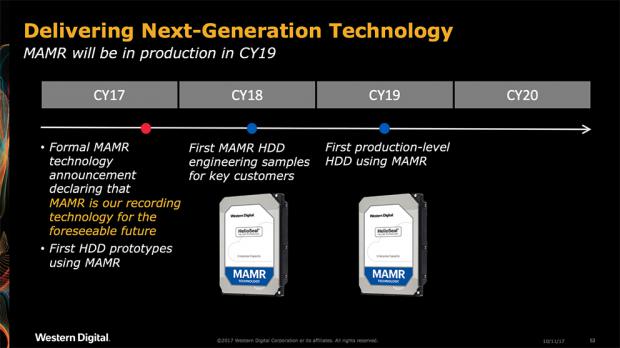
Western Digital has produced prototype MAMR drives this year, and would give engineering samples to key customers in 2018 and start volume production in 2019. By 2025, further refinement of the technology would push capacities past 40TB. Currently the largest hard disk drive (HDD) that stores data on spinning disks can hold about 14TB of information. The bigger drives were made possible by finding a way to use microwaves to write data on 3.5in drives. The first bigger-capacity drives should go on sale in 2019.
Western Digital is able to demonstrate MAMR gains significantly above PMR by leveraging three breakthroughs: the design of a head structure in dimensions that allow for high track density, the selection of magnetic and non-magnetic materials that provide the right excitation and a manufacturing process that makes it feasible to mass produce at the required performance and reliability levels.