










Breaking News
 No Benefits: Why Most Americans Hate The Idea Of AI Data Centers
 Are America's Youth Really Embracing Socialism?
 Are We About to See a Foreclosure WAVE Hit the US Housing Market?
 They Rolled Out the Relics - Then Cut the Working-Lands Money
Top Tech News
 World's smallest CT scanner fits in the palm of your hand
 The Tesla Roadster will blow people's minds
 Peter Thiel-Funded Company Anduril to Triple the Number of Autonomous Surveillance Towers...
 Quantum computing may soon become part of the microscope itself.
 Volkswagen Just Unveiled The Most Efficient EV Ever Tested
 NASA Super Light Solar Sail Project Will Be 12-40 Times Lighter and Faster
 Space Telescope Interferometer to Image Exoplanet Continents
 Twenty-five years of "temporary": how 9/11 built a surveillance state Americans never vote
 I'll Never Buy Another WALMART Battery!
 Shoei GT-Air 3 Smart helmet drops with built-in AR for $1,500



Very small modular nuclear fission reactors for military and space applications
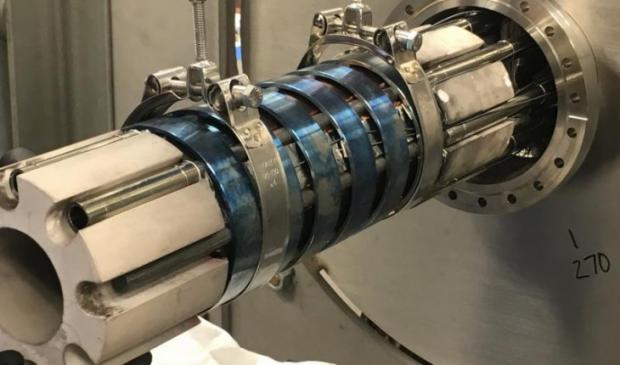
The Task Force reviewed several nuclear reactor concepts that differ in size and technology from conventional commercial reactors and the small modular reactor (SMR) concepts currently under development for commercial use. Some of these reactors, very small modular reactors (vSMRs) with an output less than 10 MWe (megawatts-electric), may be transportable and deployable in FOB, ROB, and expeditionary force situations, and could eliminate the need for logistics fuel otherwise dedicated to producing electrical power.
In Iraq and Afghanistan, between 70%7 and 90% of the volume of goods delivered to forward bases and expeditionary forces were accounted for by fuel and (to a lesser extent) water.
Costs of up to $400 per gallon of fuel have been reported in the media for air-dropped fuel, though the FBCE of truck-delivered fuel during combat is more typically reported to be between $10 and $50 per gallon.
The Task Force found two of the concepts more technically mature than the others. The first is LANL's MegaPower Reactor System and the other is Filippone and Associates LLC's "Holos" Gas-cooled Hardened Micro Modular Reactor.