










Breaking News
 California Declares State Of Emergency Ahead Of Strong El Niño
 'Pausing' Intensifies: OpenAI Unleashes Latest Model Minutes After Dario Dumps Magnum Opus
 Trump Calls For Diesel Export Ban After 3-Hour 'Very Productive' Iran Talks
 Wendy's faces 300 closures across 15 states due to crippling beef prices
Top Tech News
 BEYOND THE MOON: NASA plans a nuclear-powered fleet to push DEEPER into space
 Big Oil Backs Mazama's $135 Million Bet On Superhot Geothermal
 Quantum compass takes flight on Northrop's Lumberjack drone
 Terrifying AI Behavior Even Its Creators Couldn't Explain
 WW3 Near-Miss? AI Hallucinated Nuclear Weapons Components Aboard Chinese Vessel Bound For Iran
 Stripe Is Building the Toll Road for the Machine Economy
 Toyota Dakar hopeful swaps twin-turbo V6 for hydrogen fuel cells
 4-min turbo-inflatable cubic camp castle is now available in the USA
 Researchers Used Claude To Hack OpenAI Employee Accounts
 Chinese Scientists Develop New Oil Refining Method That Cuts Energy Use by 90%



This Ancient Building Technique Could House Millions Of People In Africa
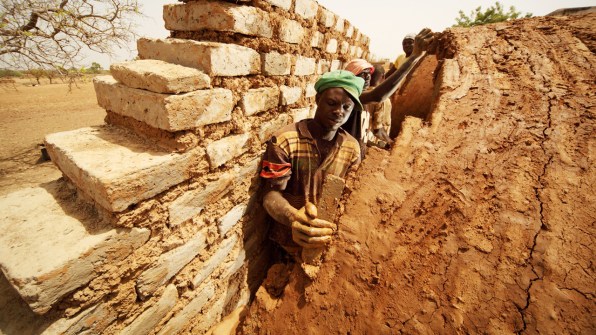
In Sahelian Africa, a region that spans the continent and is bordered by the Sahara to the north and the Sudanian Savanna to the south, the roofs of many houses are built with bush timber and straw. But amid population growth and rapid deforestation in the region, people have begun to seek out an alternative: corrugated iron sheets, imported from Europe, that are expensive and have to be replaced every five to seven years.
Though they're more "modern," these roofs have failed to deliver sustainable housing to the majority of people in the region. "To build their houses, they have to dip into their meager food, health, and education budgets to buy these imported and expensive materials, which plunges them into a vicious circle of poverty," Cécilia Rinaudo, deputy director of the Nubian Vault Association (AVN) tells Fast Company.
Since 2000, AVN has been working to implement a solution to the region's housing crisis that looks not to modern techniques, but far into the past. The Nubian vault technique was used to build houses in ancient Egypt; instead of relying on a timber frame to support the structures, sun-dried mud blocks are stacked on a foundation of rocks to create a vaulted roof that supports itself. The construction method had been long forgotten, but was rediscovered in the 1940s by the Egyptian architect Hassan Fathy, who advocated for the technique as a viable housing option for the poor.