










Breaking News
 California Declares State Of Emergency Ahead Of Strong El Niño
 'Pausing' Intensifies: OpenAI Unleashes Latest Model Minutes After Dario Dumps Magnum Opus
 Trump Calls For Diesel Export Ban After 3-Hour 'Very Productive' Iran Talks
 Wendy's faces 300 closures across 15 states due to crippling beef prices
Top Tech News
 BEYOND THE MOON: NASA plans a nuclear-powered fleet to push DEEPER into space
 Big Oil Backs Mazama's $135 Million Bet On Superhot Geothermal
 Quantum compass takes flight on Northrop's Lumberjack drone
 Terrifying AI Behavior Even Its Creators Couldn't Explain
 WW3 Near-Miss? AI Hallucinated Nuclear Weapons Components Aboard Chinese Vessel Bound For Iran
 Stripe Is Building the Toll Road for the Machine Economy
 Toyota Dakar hopeful swaps twin-turbo V6 for hydrogen fuel cells
 4-min turbo-inflatable cubic camp castle is now available in the USA
 Researchers Used Claude To Hack OpenAI Employee Accounts
 Chinese Scientists Develop New Oil Refining Method That Cuts Energy Use by 90%



Family Thrives In The Arctic Circle By Building Cob House Inside A Solar Geodesic Dome
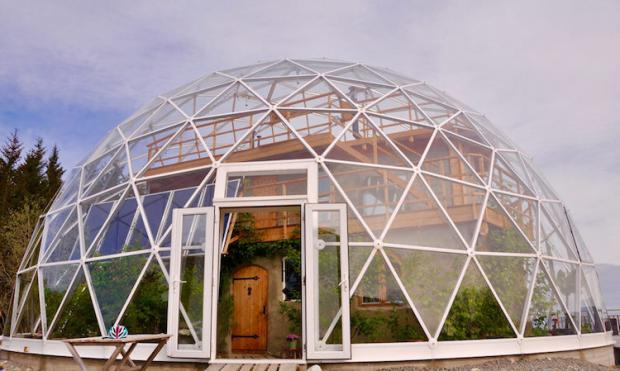
Few people can handle the frigid temperatures of winter, let alone contemplate what it must be like to live in the Arctic Circle. However, one Norwegian family has managed to not only survive, but thrive, up North, and has done so in sustainable fashion.
Inhabitat reports that the Hjertefølger family has been living on Sandhornøya island in Norway since 2013, and has done so by living in a three-story cob home called the Nature House. Constructed from sand, water, clay, and other organic materials, the structure took just three weeks to build and is surrounded by a functional and solar geodesic dome.
The SOLARDOME encasement is 25-foot high and completely encapsulates the five-bedroom, two bathroom abode. This building protects the six-person family from strong winds and heavy snow loads. Additionally, it helps to drastically reduce the heating bill.
Because the geodesic dome extends past the cob home, there is room for a garden area which supplies the family with apples, cherries, plums, apricots, kiwis, grapes, cucumbers, tomatoes, herbs, squash and melons – basically, much of their food supply. The family is able to subsist sustainably despite living without sunlight for three months every year.
"We love the house; it has a soul of its own and it feels very personal. What surprises us is the fact that we built ourselves anew as we built the house. The process changed us, shaped us."
It's been three years since the Hjertefølger family moved to the Arctic Circle, and they have no intention of leaving the sanctuary that's been built.
"The feeling we get as we walk into this house is something different from walking in to any other house," Hjertefølger shares. "The atmosphere is unique. The house has a calmness; I can almost hear the stillness. It is hard to explain. But it would have been impossible getting this feeling from a house someone else has planned and built for us, or a house with corners and straight lines."