










Breaking News
 The Economist Who Predicted 2008 Explains China's Endgame
 Charlie Kirk SNAPS at Anti White Masked ANTIFA
 Episode 488: THE FAUCI FIRESTORM
 Discussion with Glen Diesen
Top Tech News
 Voyager 1 approaches one light day from Earth
 Visual Implants
 Renewable Energy Breakthrough! World's Most Efficient Tesla Turbine System
 I Told You So
 Meet Sunbird, a nuclear fusion-powered space tug concept from Pulsar Fusion.
 China and Russia launch 29-nation AI alliance to rival western control of technology
 BREAKING: China has begun manufacturing domestically developed Immersion Deep...
 Idaho's High Desert Becomes Hot Spot For Nuclear Power Revolution
 The World's Largest Electric Aircraft Is About to Take Its First Flight
 Tesla Cybercabs and Superchargers Will Act as Mini Cell Towers for SpaceX Starlink



China's launch of quantum satellite major step in space race
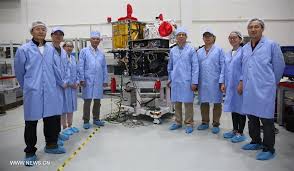
BEIJING (AP) — China's launch of the first quantum satellite Tuesday will push forward efforts to develop the ability to send communications that can't be penetrated by hackers, experts said.
The satellite launched into space from the Jiuquan launch base in northwestern China's Gobi desert will allow Chinese researchers to transmit test messages between Beijing and northwestern China as well as other locations around the world.
If the tests are successful, China will take a major step toward building a worldwide network that can send messages that can't be wiretapped or cracked through conventional methods.
"It moves the challenge for an eavesdropper to a different domain," said Alexander Ling, principal investigator at the Centre for Quantum Technologies in Singapore. "Lots of people around the world think having secure communications at a quantum level is important. The Europeans, the Americans had the lead, but now the Chinese are showing the way forward."
Quantum communications use subatomic particles to securely communicate between two points. A hacker trying to crack the message changes its form in a way that would alert the sender and cause the message to be altered or deleted.
Researchers around the world have successfully sent quantum messages by land. But a true satellite-based network would make it possible to send quickly encrypted messages in an instant around the world and open the door to other possible uses of the technology.
Cybersecurity has been a major focus in recent years for China, which has pushed regulations aimed at limiting technology imported from the U.S. in the wake of Edward Snowden's revelations of widespread surveillance by the U.S. through the use of American hardware.
China has in turn been repeatedly accused by the U.S. of hacking into computer systems to steal commercial secrets and information that could harm American national security. China has rejected claims that it runs a state-sponsored hacking program and says that it is among the leading victims of cybercrime.
Quantum messaging could become a major defense against hackers and have applications ranging from military and government communications to online shopping.
The biggest challenge, Ling said, is being able to orient the satellite with pinpoint accuracy to a location on Earth where it can send and receive data without being affected by any disturbances in Earth's atmosphere. The results of China's tests will be closely watched by other research teams, he said.
"It's very difficult to point the satellite accurately," Ling said. "You're trying to send a beam of light from a satellite that's 500 kilometers (310 miles) above you."