










Breaking News
 EXCERPTS: Citigroup Inc. received approval to launch a wholly-owned securities business...
 The Crown Wants It Kept Secret: AG Asks the Federal Court to Seal Information...
 The Supreme Court Just Denied Your Constitutional Rights
 The state is trying to crush the Amish with ruinous penalties.
Top Tech News
 Modular phone promises total privacy at the flick of a switch
 Genetically Engineered War Dogs for 134 Pound Cyborg Dire Wolves Now – Later 600 Pound Wolves
 They're Quietly REPLACING Our Food With THIS… And Nobody Is Talking About It!
 Chicago Opens First "Teacher-Free" AI School as Global Push Accelerates
 Solar Panels Are Doing Something Nobody Expected
 DeLorean climbs skyward to race electric flying cars
 Atari's 800XL returns with a keyboard, cartridges and BASIC
 Bioinspired robot airdrops into remote waters via morphing wing-sail
 Anduril interceptor adapts to emerging threats via swappable stages
 I Built a Website to Expose Solar and Battery Scams


Retail demand for organics is exploding so rapidly that Costco is actually lending money to farmers
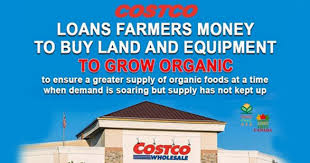
NaturalNews) In news that will be embraced by health-conscious consumers and organic farmers alike, Costco is finding the demand for organic food to be so staggering, that it is lending money to farmers so they can grow enough organic food to keep up.
The Seattle Times reports that Costco came up with this brilliant solution in response to the growing demand by its customers for organic produce. In fact, organic food is one of the quickest growing types of food in terms of sales numbers, a strong sign that people really are starting to insist on clean food that has not been adulterated by toxic chemicals.
Costco's CEO, Craig Jelinek, said that they simply "cannot get enough organics to stay in business day in and day out."
In one of several new initiatives, the firm will lend money to San Diego's Andrew and Williamson Fresh Produce (A&W) so that they can purchase 1,200 acres of land in Baja California, along with the equipment needed to grow the food.
The idea was born when Costco's senior vice president of fresh foods, Jeff Lyons, toured the produce company. Their experience growing organic produce impressed him, but he saw that they lacked the funds to purchase additional land to expand these organic growing efforts. As part of the loan, Costco has also purchased the first rights on everything that comes off the land that meets certain requirements.
Lyons told the Seattle Times: "By helping them with financing, we got access to and purchased about 145,000 cases of organic raspberries that we normally would not have access to."
It's a win-win situation, as A&W can increase its presence and operations in the organic food industry, while Costco can boost its business. The biggest winners of all, however, will be consumers, who are increasingly clamoring for healthy, organic produce options.
This is just the latest move that shows how seriously Costco takes the health of its consumers. It has already shunned genetically modified salmon in its stores. It has also contracted with farmers in Nebraska to raise their cattle on organic fields, and it has been sourcing its wild shrimp from the Sea of Cortez, to avoid slave labor produced shrimp that comes from Thailand.
The sales numbers of food from organic farms have risen dramatically, with spending on organics enjoying a 72 percent jump since 2008. Costco is the world's second-biggest retailer. It sold around $4 billion worth of organic food last year across its 487 stores, making it the nation's top organic grocer, and giving Whole Foods a run for its money.
Pacific Foods and Nature's Path also have their own organic farms, while Whole Foods launched a $25 million increase for its Local Producer Loan Program in recent years. The Whole Foods program supports non-GMO animal feed, sustainable packaging, biodynamic farming and pollinator health. Chipotle Mexican Grill has also started funding organic farming operations.