










Breaking News
 The Economist Who Predicted 2008 Explains China's Endgame
 Charlie Kirk SNAPS at Anti White Masked ANTIFA
 Episode 488: THE FAUCI FIRESTORM
 Discussion with Glen Diesen
Top Tech News
 Voyager 1 approaches one light day from Earth
 Visual Implants
 Renewable Energy Breakthrough! World's Most Efficient Tesla Turbine System
 I Told You So
 Meet Sunbird, a nuclear fusion-powered space tug concept from Pulsar Fusion.
 China and Russia launch 29-nation AI alliance to rival western control of technology
 BREAKING: China has begun manufacturing domestically developed Immersion Deep...
 Idaho's High Desert Becomes Hot Spot For Nuclear Power Revolution
 The World's Largest Electric Aircraft Is About to Take Its First Flight
 Tesla Cybercabs and Superchargers Will Act as Mini Cell Towers for SpaceX Starlink



Quantum cryptography breakthrough may lead to more secure communications
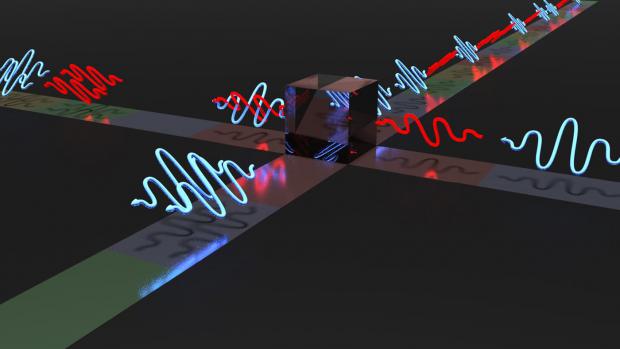
Many of the encryption methods that keep our online data safe rely on a digital key which is very hard for computers to crack – for instance, requiring the identification of two very large prime numbers, which standard computers are very poor at. But if a powerful quantum computer were to be built, it could crack these types of code with ease and jeopardize the safety of our digital communications.
The only encryption method that has been proven to be completely secure if applied correctly – quantum computers or not – is the so-called "one-time pad." Here's how it works: first, a secret digital key is created consisting of a completely random sequence of bits. The key is then securely sent to the receiver, and kept private. Now, the sender can encrypt his message by adding the message's bits to the random bits of the key. Under these conditions, the code is deemed truly uncrackable.
Keeping the key secret can be a challenge, but quantum physics can come to the rescue. That's because the weird and wonderful properties of quantum mechanics make it so that if someone were to try and intercept it, the key itself would change and both the sender and the receiver would immediately notice.