










Breaking News
 Is Big Pharma Selling Postpartum Depression to New Moms?
 Make Men Men Again: Low T Is Now a National Defense Problem
 Druski: They're Lying To You About Overnight Success!
 $6.27 Diesel Just Hit Harvest. The Grocery Aisle Hasn't Felt It Yet.
Top Tech News
 Tesla Model 3 killer charges from 10 to 97% in just 9 minutes
 World-first unpowered DNA computer sets speed record
 I Power 5 Buildings Off-Grid. Here's How
 The US government is pushing hard to get a working nuclear fission reactor into space by late 2028
 SpaceX Starmind AI in Space Radiator
 China Will Dominate Global Nuclear Energy Through 2035, Analyst Says
 These Absolutely Wild-Looking EVs Are Saudi Arabia's First Homegrown Cars
 BEYOND THE MOON: NASA plans a nuclear-powered fleet to push DEEPER into space
 Big Oil Backs Mazama's $135 Million Bet On Superhot Geothermal
 Quantum compass takes flight on Northrop's Lumberjack drone


Truly zero-emissions airplane fueled by nothing but algae and sunlight
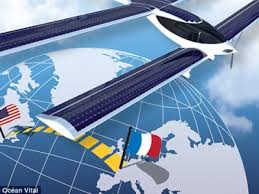
(NaturalNews) Engineers have said that the day of carbon-free, unlimited energy is coming, and a French company just took a step toward that goal.
The company says it plans to fly a "zero-emission" plane from Paris to New York City, powered by nothing more than sunlight and some algae. Founder and pilot Raphael Dinelli will travel for more than 60 hours in June in an ultra-light electric aircraft that is biofuel- and sunlight-powered, the UK's Daily Mail reported.
If the trans-Atlantic flight is successful, the company, Laboratoire Ocean Vital, plans to build an even larger commercial version that will be able to carry passengers on the 3,625-mile journey.
The plane, called Eraole, is definitely a hybrid craft, with about 55 percent of its engine power coming from a special fuel the company developed using micro-algae. In addition, solar cells that line the aircraft's wings will provide another 25 percent of its power, while the wind – gliding – provides the remaining 20 percent. In addition, the company says, takeoffs and landings will be further aided by two lithium batteries.
The plane has been under development for seven years, and the company is promising that it will have zero carbon emissions. That said, most biofuels do actually produce some greenhouse gases, though far below what a conventional jet engine produces.
Long flight but history will be made
An average airliner's round-trip between Europe and the U.S. adds about two to three tons of carbon dioxide to every passenger's so-called "carbon footprint," the Daily Mail reported. Overall, air travel is believed to create about 11 percent of CO2 emissions from transportation, and about 2 percent of overall world emissions.
However, although the Eraole's journey is going to be more environmentally friendly, the trip will nevertheless last about 10 times longer than a commercial flight. In addition, it will be twice as long as Charles Lindbergh's Spirit of St. Louis Paris-to-New York trip some 90 years ago, which lasted only about 30.5 hours.
That means that Dinelli will have to spend two-and-a-half days in the compact single-seat aircraft, which does not have autopilot or room for a co-pilot. He therefore won't be able to sleep, and there is little room to move his legs.
What's more, the small aircraft's cabin is not even pressurized, so he'll have about 30 percent less oxygen to breathe than usual, all of which means there is some danger involved in making the flight.