










Breaking News
 Trump's "Russian sanctions" Have Destroyed the German Automobile Industry
 Where are the headlines? 2026 is the 'First Time in 112 Years: No Atlantic Hurricanes By Sept. 2
 CNN Staffers Panic over Paramount Merger: 'Bloodbath Coming,' Newsroom Is 'Like a Funera
 Tesla Model 3 killer charges from 10 to 97% in just 9 minutes
Top Tech News
 BEYOND THE MOON: NASA plans a nuclear-powered fleet to push DEEPER into space
 Big Oil Backs Mazama's $135 Million Bet On Superhot Geothermal
 Quantum compass takes flight on Northrop's Lumberjack drone
 Terrifying AI Behavior Even Its Creators Couldn't Explain
 WW3 Near-Miss? AI Hallucinated Nuclear Weapons Components Aboard Chinese Vessel Bound For Iran
 Stripe Is Building the Toll Road for the Machine Economy
 Toyota Dakar hopeful swaps twin-turbo V6 for hydrogen fuel cells
 4-min turbo-inflatable cubic camp castle is now available in the USA
 Researchers Used Claude To Hack OpenAI Employee Accounts
 Chinese Scientists Develop New Oil Refining Method That Cuts Energy Use by 90%



The World Is Racing to Build a Moon Base -- Here's What It Could Look Like
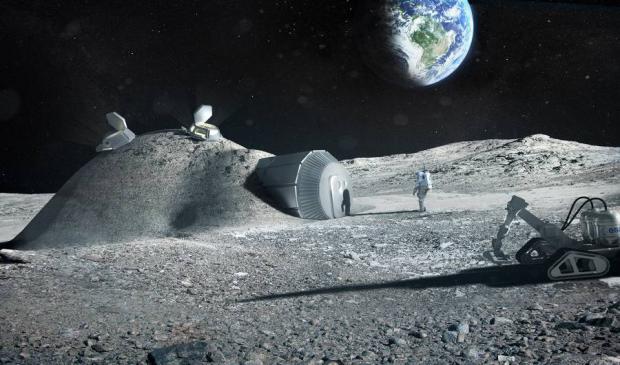
The European Space Agency just reminded the world that it wants to build a base on the moon by 2030, using 3-D printed parts made from materials found on the lunar surface.
The ESA has some competition. Earlier this month, Congress passed a spending bill that would give NASA $55 million to build a space habitat for deep-space exploration, including both the space within the moon's orbit and, eventually, Mars. The only catch: NASA has 180 days to show what it's going to be.
It's a global space race to live on the moon. Around 26 nations want to figure out what that's going to look like.
In the past, NASA has been a big fan of expandable, inflatable modules, like the ones made by Bigelow Aerospace. The ESA's concept art shows buildings made out of the natural elements found on the lunar surface. This idea isn't far-fetched; product designers have used sand to print in the past.
NASA already uses a 3-D printer that's able to print in a vacuum. It can build tools and little bits and pieces for the International Space Station that would otherwise be tremendously expensive to send. If the walls, or even the entire structure, could be built on the moon instead of being shipped, we could have pretty large structures. Earlier this year, an architect revealed his own plans to 3-D print a 2,400-square-foot house using just dust, sand and gravel. And that one had a swimming pool, jacuzzi and garage.
