










Breaking News
 The Economist Who Predicted 2008 Explains China's Endgame
 Charlie Kirk SNAPS at Anti White Masked ANTIFA
 Episode 488: THE FAUCI FIRESTORM
 Discussion with Glen Diesen
Top Tech News
 Voyager 1 approaches one light day from Earth
 Visual Implants
 Renewable Energy Breakthrough! World's Most Efficient Tesla Turbine System
 I Told You So
 Meet Sunbird, a nuclear fusion-powered space tug concept from Pulsar Fusion.
 China and Russia launch 29-nation AI alliance to rival western control of technology
 BREAKING: China has begun manufacturing domestically developed Immersion Deep...
 Idaho's High Desert Becomes Hot Spot For Nuclear Power Revolution
 The World's Largest Electric Aircraft Is About to Take Its First Flight
 Tesla Cybercabs and Superchargers Will Act as Mini Cell Towers for SpaceX Starlink



A GLOVE THAT LETS YOU FEEL WHAT'S FAR BELOW THE WATER
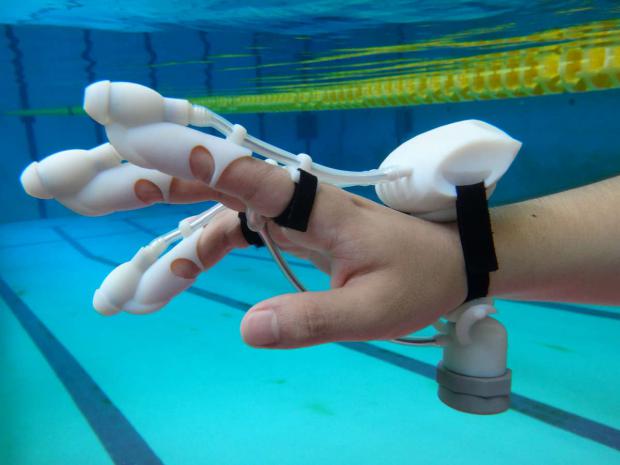
A haptic sonar glove developed by Ph.D. candidates Aisen Carolina Chacin and Takeshi Ozu of the Empowerment Informatics program at Tsukuba University in Japan allows wearers to "feel" objects that are just out of reach in underwater settings. In situations where there's limited visibility, like flooded streets in an emergency, gloves like these could prove especially useful.
Inspired by the dolphin, IrukaTact (iruka means 'dolphin' in Japanese) uses echolocation to detect objects below the water, and provides haptic feedback to the wearer with pulsing jets of water. As the wearer's hand floats closer to a sunken object, the stronger the jets become, and the wearer feels more pressure on her fingertips. Since the apparatus has minimal bulk, the wearer can grasp objects easily after they've been found.
"Our overall goal was to expand haptics," says Chacin. "How can you feel different textures or sense depth without actually touching the object? Vibration alone doesn't cut it for me, or most people, for that matter."